
Reviewed · ANCIENT CORINTH & CANAL DAY TRIPS
Biblical Corinth Taste Faith & History with wine & Oil Tasting
Corinth can feel like a whole other country. This private half-day tour strings together big ancient ideas, from the Corinth Canal to Acrocorinth, with Bible context built in. I especially like the small-group setup, since you get a real back-and-forth with the driver instead of yelling over a bus.
I also love that the day blends monuments with the practical stories behind them. The Corinth Canal and the nearby Diolkos let you see how people solved real shipping problems, and that makes the ruins click. In the same spirit, drivers like Panos and Periklis have a knack for tying local sites to wider events, including connections to battles people remember from Greek history.
One thing to consider: the biggest archaeological stop can sometimes be closed on specific days for filming and safety reasons. When that happens, your plan can shift, even with a great driver, because access is out of the operator’s control. I recommend keeping expectations flexible, especially if you’re traveling on a Tuesday.
In This Review
- Key highlights to know before you go
- Corinth to Acrocorinth: why this route makes sense in one day
- Private Athens pickup and the mini-van pace
- Corinth Canal: where shipping becomes strategy
- The Diolkos: how ancient engineers “short-cut” ships
- Isthmia and the Isthmian Games, plus Apostle Paul context
- Archaeological Museum of Isthmia: artifacts you can actually picture
- Ancient Corinth (Archaia Korinthos): the city that kept getting rebuilt
- The Archaeological Museum of Corinth and the site you see between ruins
- Temple of Apollo: one of the earliest Doric temples in the region
- Acrocorinth: the fortress and the payoff of going up
- Taste add-ons: wine and oil, and how to plan for value
- Price and logistics: what you’re really paying for
- Driver-led history, names you might hear, and when to add a guide
- Planning tips for a smooth day
- Should you book this Biblical Corinth Taste Faith & History tour?
- FAQ
- How long is the tour?
- Is pickup from Athens included?
- Is this a private tour or a group bus?
- Are entrance fees included in the price?
- Is a licensed tour guide included?
- Are wine and oil tastings included?
- What if weather is bad or major sites are closed?
Key highlights to know before you go
- Private small group (up to 7 pax) with pickup from Athens hotels, apartments, and ports
- Corinth Canal and the Diolkos trackway, built on a 2000-year-old dream
- Isthmia and the Isthmian Games, with Apostle Paul context tied to the games
- Ancient Corinth + Acrocorinth, including fortress views from the monolithic rock
- Optional wine and oil tasting, if you want the faith-and-food theme to land
- Museum time, including finds like colored glass from Alexandria
Corinth to Acrocorinth: why this route makes sense in one day
Corinth is one of those places where history comes at you from multiple angles. You get the strategic story of the isthmus, the commercial muscle of a major city, and then the spiritual layer tied to Apostle Paul in the New Testament. When you pair the ruins with the views from Acrocorinth, it becomes easier to understand how power worked here.
This tour is designed around that logic: start with the geography that shaped trade, then move toward the religious and city life of ancient Corinth. With only your group in the vehicle, you can ask the easy questions too, like why a canal mattered, or how a fortress controls a whole region.
Other ways to spend the day near Athens
- From Athens: Ancient Corinth Day Trip with Canal & VR Guide
★ 4.6 · 1,073 reviews - Private Biblical Tour Ancient Corinth & Isthmus Canal from Athens
★ 5.0 · 762 reviews - Athens: Ancient Corinth & Nafplio Full Day Trip with Swim
★ 4.8 · 531 reviews
Private Athens pickup and the mini-van pace
The experience starts with pickup offered in Athens. The driver meets you at your hotel lobby, at your apartment entrance, or at the port gate, and they return you to the same meeting point at the end. You also get modern private transport with WiFi, A/C, and bottled water, which matters when you’re trying to stay comfortable during a 5-hour window.
Group size is small by design. People are either in a luxury sedan for 1 to 3, or in a mini van for 4 to 7. That usually means fewer time traps, because the vehicle plan doesn’t depend on herding strangers.
You’ll also want to think about how the timing works. A 5-hour tour is long enough to feel the main highlights, but it is not long enough to wander without boundaries. If your style is slow museum browsing, plan to pick your must-sees and accept that you will not see everything.
Corinth Canal: where shipping becomes strategy
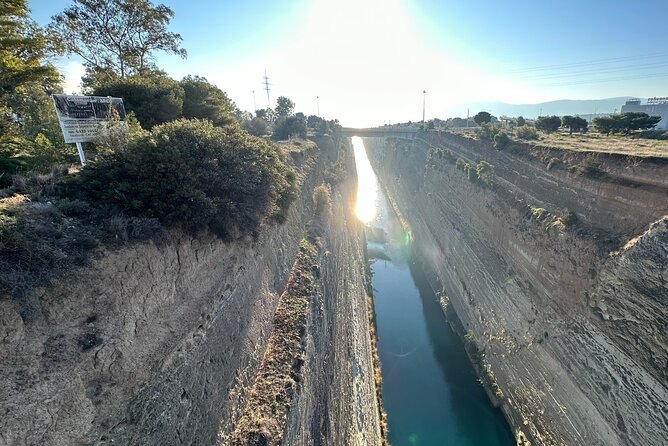
The Corinth Canal is one of the clearest examples of “geometry with consequences.” It cuts across the narrow isthmus of Corinth to link the Gulf of Corinth with the Saronic Gulf, and in doing so it turns the Peloponnese into something like an island.
The story behind it makes the stop more interesting than just standing by water. The canal was completed in the late 19th century, but the dream is often traced back two millennia. Before the canal, ships that wanted to reach destinations in the Adriatic area could end up making a detour around the Peloponnese, adding an extra 185 nautical miles.
Periander, the tyrant associated with Corinth around 602 BC, is also linked to the earlier idea of solving the problem. Instead of digging the canal, the ancients used a land transfer system, the Diolkos, which becomes the next stop in your mental timeline.
The Diolkos: how ancient engineers “short-cut” ships
Right by the canal concept, the Diolkos adds a brilliant layer. This was a paved trackway used to move boats over land across the isthmus. The goal was simple: avoid the long and dangerous circumnavigation.
Here’s the fun detail: the Diolkos was known for speed, so fast that the expression as fast as a Corinthian stuck in comedy. The system was about moving goods most of the time, but in war it could also speed up naval campaigns.
The route length is described as about 6 km to 8.5 km, operating roughly from around 600 BC to the middle of the 1st century AD. Even without seeing every physical remnant, it helps you understand Corinth as a place built for movement, not just temples.
A short hop away, these too:
- Athens: Acropolis & up to 5 Archaeological Sites Combo Pass
★ 4.2 · 13,904 reviews - Athens: Acropolis, Parthenon & Acropolis Museum Guided Tour
★ 4.8 · 9,316 reviews - The Acropolis, Parthenon & Acropolis Museum Guided Tour
★ 4.7 · 8,493 reviews - Athens: Cape Sounion & Poseidon Temple Sunset Half-Day Trip
★ 4.8 · 8,241 reviews
Isthmia and the Isthmian Games, plus Apostle Paul context
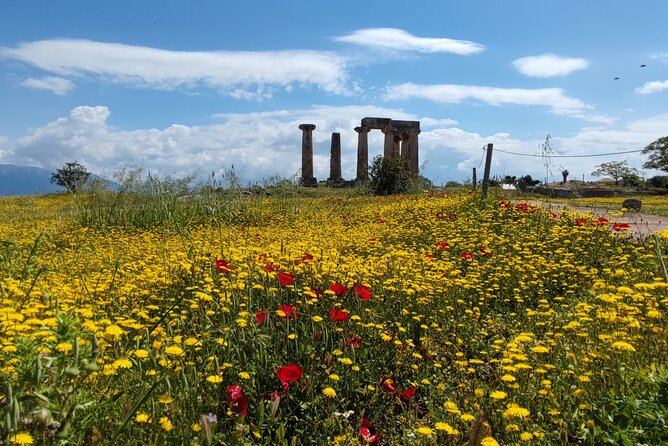
Isthmia is where geography and faith overlap in a way that feels real. The area sits near the canal and at the joining point between Peloponnese and Central Greece, so it naturally became a gathering point. It also hosted major athletic festivals in the ancient world, the Isthmians.
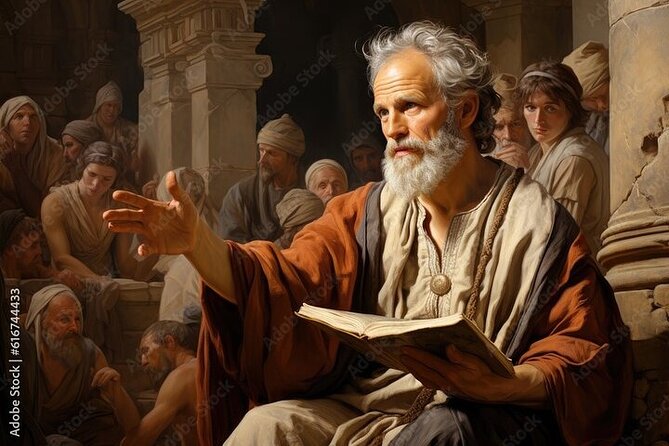
The Bible connection here is specific and worth paying attention to. Apostle Paul is considered important in relation to the Isthmian games because references tie him to the event. In this context, Paul worked as a tent maker to support athletes and visitors, and his message was part of the public presence during the games.
Even if you are not a scholar of the New Testament, this framing gives the sites a purpose beyond sightseeing. You are not just looking at stones, you’re following a social system where crowds, hospitality, and public preaching all mixed.
Archaeological Museum of Isthmia: artifacts you can actually picture
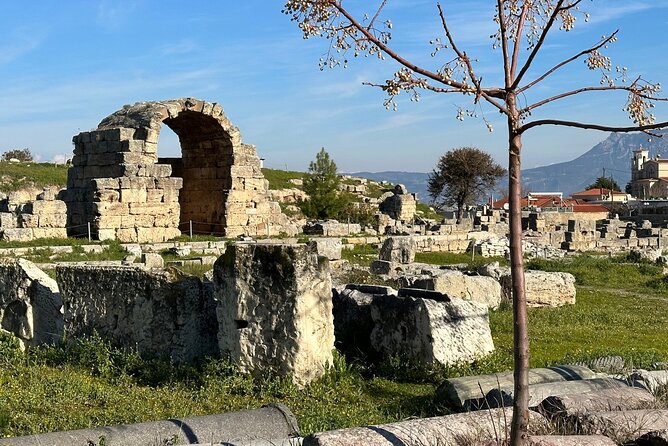
The Archaeological Museum of Isthmia is a short stop, but the items listed here give you something tangible to hold in your mind. You might see an archaic marble pediment dated to the end of the 7th century BC that was placed at the entrance of the first Temple of Poseidon.
One of the standout types of finds is the glazing from Kechreon. The museum includes colored glass sections that arrived packed in twos on a ship from Alexandria, Egypt. They were found submerged on the floor of the Temple of Isis, and the imagery includes harbor views, exotic landscapes, animals and plants, and figures such as philosophers like Homer and Plato, plus ships and geometric borders.
Other objects described include an imperial statue in the type of Zeus (mid 2nd century BC), an epinician stele featuring a Corinthian musician Lefkios Cornelius (150 AD), and animal figurines with a golden bull that functioned as a vow to the sanctuary (6th century BC).
This is a helpful museum for people who feel restless at ruins. When the artifacts are this specific, you can build a mental picture quickly.
Ancient Corinth (Archaia Korinthos): the city that kept getting rebuilt
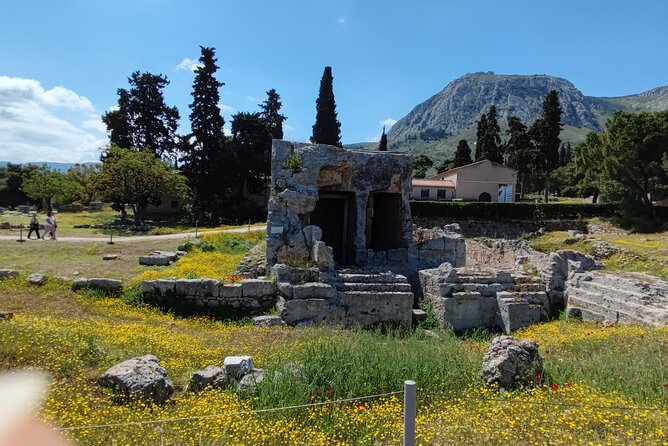
Ancient Corinth is famous not only for its scale but for its cycle of destruction and renewal. Corinth grew into one of the largest and most important Greek cities, with a population described as 90,000 around 400 BC. The Romans demolished Corinth in 146 BC, built a new city in its place in 44 BC, and later turned it into a provincial capital.
For Christians, Corinth is a major anchor point because of the two letters of Saint Paul in the New Testament. It is also mentioned in Acts as part of Paul’s travels, and Pausanias includes Corinth prominently in his Description of Greece.
This is a big stop, and it works best when you go in with the idea that Corinth was about crossroads. The isthmus made it a commercial center, and Acrocorinth acted like the security layer on top of that.
There is also a real-world catch. If you are unlucky, the archaeological site can be closed on certain days for filming and safety reasons, and you might only learn at the gate. That happened to at least one group on a Tuesday, even though the rest of the day went well.
The Archaeological Museum of Corinth and the site you see between ruins
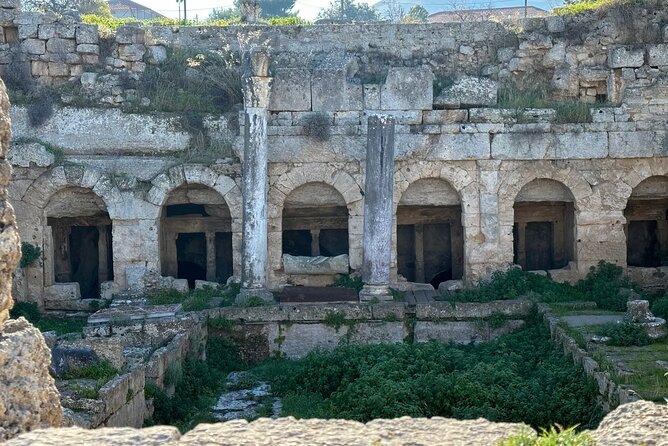
The Archaeological Museum of Corinth helps connect the pieces you might notice outside. It was constructed between 1931 and 1932 to display material from recent excavations. It sits within the ancient site, under the jurisdiction of the Greek Archaeological Service.
The museum is described as tied to key areas and features you might otherwise feel are scattered. These include the Hadgimoustafa spring, the Lechaion Road, the Basilica, the Fountain of Peirene, the Stoa, the Agora, and the Odien. Even in a short visit, this kind of map-like framing can make the walking feel less random.
If your main goal is faith-and-history, this stop is useful because it anchors biblical Corinth to physical spaces. If you are a history-first person, it gives you names and context to keep from losing the plot.
Temple of Apollo: one of the earliest Doric temples in the region
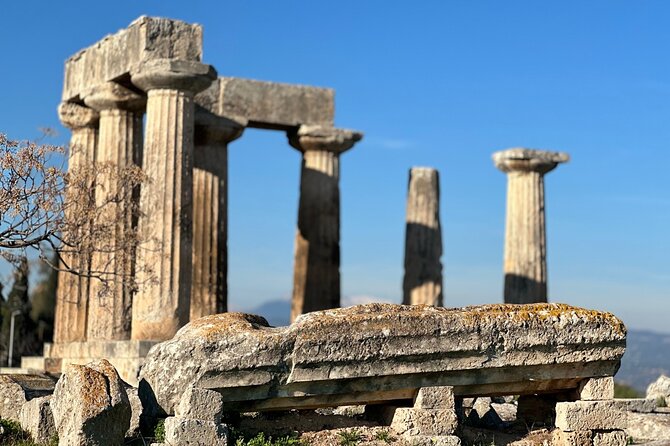
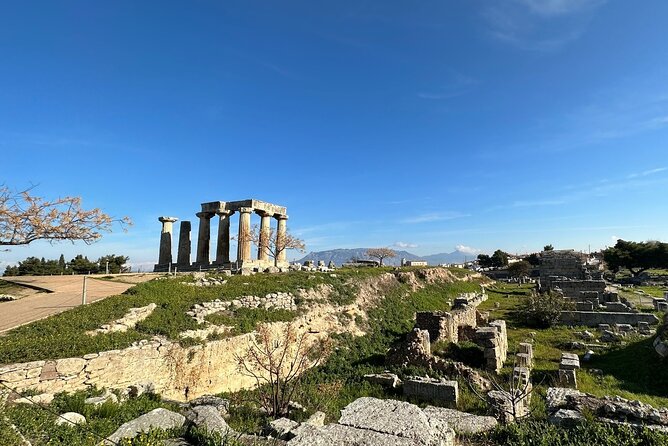
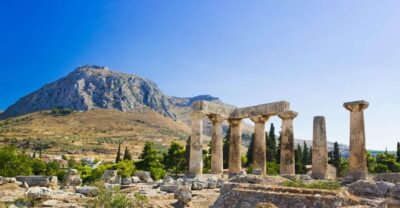
The Temple of Apollo at Corinth was constructed around 550 BC. It is described as one of the earliest Doric temples in the Peloponnese and the Greek mainland, with monolithic columns that were rare in the ancient world.
This is where you get a sense of style evolution and local building ambition. Corinth may be known for trade and later Roman history, but it also had the religious infrastructure and civic pride that came with major temples.
The time here is short, so treat it like a reset point. Look at the proportions, note the Doric style, and then use Acrocorinth to understand how sacred spaces and defense planning could exist in the same landscape.
Acrocorinth: the fortress and the payoff of going up
Acrocorinth, meaning Upper Corinth, is a fortress on a monolithic rock above the ancient city. It controlled the Isthmus of Corinth and served as a last line of defense for southern Greece by repelling forces trying to enter the Peloponnese by land.
The description highlights why the view matters. The fortress’s secure water supply was part of what made it defensible, and that kind of practical planning is exactly why ancient “high places” mattered.
Expect this part to be the visual payoff. Once you look out over the region, it’s easier to grasp why Corinth ended up so important for so long. It also helps you see how a city-state could feel small in area but huge in influence.
Lunch and free time are built in. You’ll have time for shopping and a meal during that open slot, so you can eat at your pace instead of being rushed by a fixed tour script. One driver, Panos, is praised for recommending a great lunch spot, which is a good sign that you can ask for local food ideas and not get generic advice.
Taste add-ons: wine and oil, and how to plan for value
This tour is themed around faith and history with wine and oil tasting. The catch is that the tastings are not included in the base price, so you pay extra if you want them.
Oil tasting is listed as finger food for €80 per person, and wine tasting is listed at €15 per person. If you care about value, start with the wine add-on, since it’s the cheaper way to match the theme. If you’re an olive oil person or you love food pairings, then the oil tasting can be worth considering.
Because you are drinking wine during a day trip, the private driver setup is a real advantage. You do not need to figure out transit or a return ride after a tasting. That reduces friction, even if the tastings add cost.
Also remember: entrance fees are not included, and the archaeological site of Ancient Corinth has a €15 ticket listed. So your total day budget might look like tour price plus ticket plus optional tastings.
Price and logistics: what you’re really paying for
The listed price is $190.46 per person for about 5 hours from Athens. For that money, you get a private vehicle with A/C and WiFi, English communication led by a driver well-versed in Greek history, and pickup and drop-off that returns you to the same meeting point.
That added cost compared with a bus tour is mostly about control. In a small group, you can adjust the pace, ask follow-ups, and get practical help on site. The reviews back up that style, with drivers like Nikos and Andreas described as entertaining, attentive, and flexible about small timing adjustments, even in situations outside the standard plan.
What is not included is where you should expect add-on costs:
- Entrance fees for attractions are listed as €15 per person, and the archaeological site ticket is listed at €15
- A licensed tour guide is optional, extra cost €140 per person
- Lunch costs are not included
- Wine and oil tasting are separate add-ons
If you want maximum value, go in with one clear priority. If Acrocorinth is your must-do, focus your energy there and accept shorter museum time. If Paul and the Bible tie-ins are your priority, you will appreciate having the driver frame the games and Corinth connections so you do not feel lost.
Driver-led history, names you might hear, and when to add a guide
One of the best parts of this experience is the driver role. The tour includes an English-speaking driver who is well-versed in Greek history. In practice, that means you are not stuck with silent transit between stops.
In the feedback tied to this experience, driver names come up again and again, including Panos, Periklis, Nikos, Andreas, and Christos. The common thread is more than friendly service. These drivers make the stops understandable, sometimes correcting what you can feel is missing on site, and they also connect the dots between places and events.
If you want extra depth and you’re the type who loves layer upon layer of context, you can also request a licensed tour guide at an additional €140 per person, depending on availability. That is expensive, so I’d treat it as an upgrade for serious history and archaeology fans.
If you’re mostly after the big picture and a smooth day, the included driver-led approach should be enough.
Planning tips for a smooth day
A few practical things can make this tour feel effortless:
- Wear comfortable shoes for Ancient Corinth and Acrocorinth, since you’re dealing with stone sites and uneven ground
- Bring a light layer, because you might move between sun and shaded areas
- If you want wine or oil tasting, plan your energy level around it, and keep your lunch flexible
- Bring a phone charger, just in case you use the included WiFi and want maps and photos
Also, keep one eye on access issues. If a major archaeological stop is closed due to filming or safety, your day can still work, but the focus may shift.
Should you book this Biblical Corinth Taste Faith & History tour?
Book it if you want a private, history-linked day that connects geography, ancient city life, and Apostle Paul context without turning your trip into a long marathon. The small group setup and driver communication are the real value, and Acrocorinth is the payoff that makes Corinth memorable.
Skip or rethink if your schedule is fixed around a specific weekday and you cannot handle the risk of a major site closing for filming and safety. In that case, you might still enjoy the canal and Isthmia stops, but your top highlight could be the one that changes.
If you do book, I’d make your decision like this: prioritize either Acrocorinth views or Paul-related context, then add wine tasting if you want the theme to feel complete.
FAQ
How long is the tour?
The tour runs for about 5 hours.
Is pickup from Athens included?
Yes. Pickup is offered from Athens hotel, Airbnb residence, or Port, and the driver waits in the lobby or at the building entrance as needed.
Is this a private tour or a group bus?
It is a private small-group tour. Only your group participates, and vehicles are a luxury sedan for 1 to 3 people or a mini van for 4 to 7.
Are entrance fees included in the price?
No. Entrance fees are not included, and the archaeological site of Ancient Corinth is listed at €15 per person.
Is a licensed tour guide included?
A licensed tour guide is optional. It costs extra at €140 per person and depends on availability.
Are wine and oil tastings included?
Wine tasting (€15 per person) and Oil Tasting finger food (€80 per person) are not included in the base price.
What if weather is bad or major sites are closed?
The experience requires good weather. If it is canceled due to poor weather, you will be offered a different date or a full refund. Site access can also be affected by filming and safety, so closures may happen on specific days.
More Historical Tours in Athens
- Historical Delphi One Day Tour with Arachova Stop & Expert Guide
★ 4.5 · 1,247 reviews - Historic Athens: Small Group Electric Bike Tour
★ 4.9 · 966 reviews - Acropolis, Parthenon & Athens Old City Heritage Walking Tour
★ 4.5 · 876 reviews - Athens: Small Group E-Bike Tour of Historic Highlights
★ 4.9 · 154 reviews
More Wine Tours in Athens
- Athens: Classic Cooking Class with Market Visit and Wine
★ 5.0 · 1,101 reviews - Athens: Food Market Visit and Cooking Class with Wine
★ 4.9 · 1,087 reviews - Best rated Acropolis Wine Tasting
★ 5.0 · 568 reviews - PREMIUM Semi-Private Athens Afternoon Food Tour & Wine Tasting
★ 5.0 · 363 reviews
Freshly listed near Athens
- Athens: Premium Guided E-Scooter Tour in Acropolis Area★ 5.0 · 133 reviews
- Athens: Wine Workshop Create your Own Wine under the Acropolis★ 5.0 · 77 reviews
- Ceramic and Pottery Creative Workshop with Two Local Artists★ 4.0 · 57 reviews
- Private Tour and Tasting at Zeginis Winery★ 5.0 · 18 reviews
- Athens: Greek Wines Tasting with Sommelier and Acropolis Views★ 5.0 · 88 reviews
- Private Day Trip to Nafplio from Athens★ 5.0 · 20 reviews
- Athens Old City Private Photoshoot Tour / 2 hrs★ 5.0 · 109 reviews
- Greek food and wine tasting★ 5.0 · 18 reviews
Ancient Corinth & Canal Day Trips, compared.
Ancient Corinth Day Trip with Canal & VR Guide
Read our review →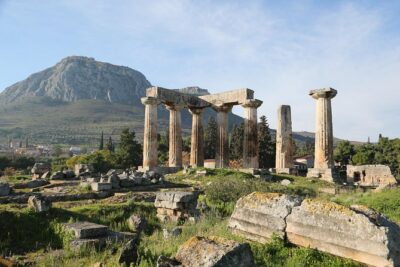
Private Biblical Tour Ancient Corinth & Isthmus Canal from Athens
Read our review →
Corinth Canal, Mycenae & Nafplio Premium Guided Tour
Read our review →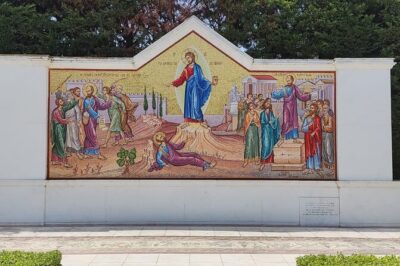
Private Tour of Apostle Paul’s Footsteps in Ancient Corinth
Read our review →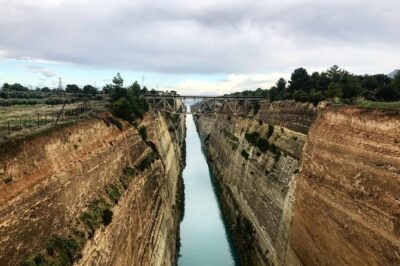
Corinth Half-Day Trip from Athens with Entrance Tickets
Read our review →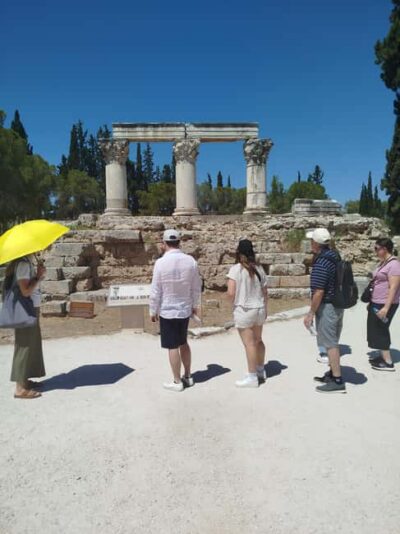
Ancient Corinth Tour with Official Guide & Tickets
Read our review →
Ancient Corinth, Epidaurus, Nafplio full day private tour from Athens
Read our review →Browse the lists this tour appears in