
Reviewed · ANCIENT CORINTH & CANAL DAY TRIPS
Ancient Sparta Ancient Corinth Private Tour from Athens/ Nafplio
Sparta and Corinth in one day feels like cheating time. You get private round-trip transportation plus a driver who keeps the story moving from the Corinth Canal to the best-preserved bits of ancient Sparta.
I love that it’s structured but not rigid, with short, sensible stop times and plenty of chances to pause for photos and lunch along the route. I also like that you learn as you go, since the driver provides an informative documentary style audio while you travel.
One thing to consider: Sparta is smaller and less dramatic than Athens, and parts of this day depend on museum hours (several museums close on Tuesdays), so plan around the calendar.
In This Review
- Key things to know before you go
- Why the Corinth and Sparta combo works (and who it suits)
- Corinth Canal: your first payoff for leaving Athens
- Sparta in real life: Lycurgus, society, and what survives
- The Sparta museum and the Roman-era theater view
- Leonidas Monument: short stop, strong symbolism
- Olive and Olive Oil Museum: should you add the optional 20 minutes?
- Ancient Corinth: your final anchor, plus the Saint Paul connection
- How the private driver makes the day feel human
- Price and value: what $265.50 covers, and what to budget for tickets
- Practical tips to make the day smoother
- Should you book this Sparta and Ancient Corinth private tour?
- FAQ
- How long is the Sparta and Ancient Corinth private tour?
- What is included in the tour price?
- Are entrance fees included?
- How much are the tickets for Ancient Corinth?
- Which museums close on Tuesdays?
- Is the Olive and Olive Oil Museum included?
- Does the driver provide expert museum guiding inside the sites?
- Where does pickup and drop-off happen in Athens?
- Can I extend the tour if I want more time?
Key things to know before you go

- Corinth Canal views fast, including a pedestrian bridge for photos above the water
- Sparta basics in plain language, from Lycurgus and social classes to what you can actually see today
- Big theater moment at the Sparta Acropolis and Ancient Theater, with Roman-period marble and a huge capacity in its prime
- Optional Olive Oil Museum, featuring fossilized olive leaves and Linear B references (and it is closed Tuesdays)
- Seasonal ticket costs for Ancient Corinth and Sparta museums, so your total price changes by month
- Private pacing, with the driver able to adjust within the agreed time (extra time can cost more)
Why the Corinth and Sparta combo works (and who it suits)
If you only have one day away from Athens, this kind of loop makes sense. Driving privately means you are not fighting buses, transfers, and timing, and you still get a long list of ancient-world stops without feeling like you are sprinting.
You will get the Aegean Ionian connection at the Corinth Canal, then shift to Sparta’s military-focused society, then finish at Ancient Corinth tied to the stories of Saint Paul. This is a strong match for you if you like history but want it organized, and if you hate standing around with no plan.
It also suits families and mixed ages because the pacing is built around set visit windows and you can ask your driver to slow down where needed. The main drawback is that this is a full day, so comfort matters: dress for walking, bring water, and expect the itinerary to be active.
Other ways to spend the day near Athens
- From Athens: Ancient Corinth Day Trip with Canal & VR Guide
★ 4.6 · 1,073 reviews - Private Biblical Tour Ancient Corinth & Isthmus Canal from Athens
★ 5.0 · 762 reviews - Athens: Ancient Corinth & Nafplio Full Day Trip with Swim
★ 4.8 · 531 reviews
Corinth Canal: your first payoff for leaving Athens
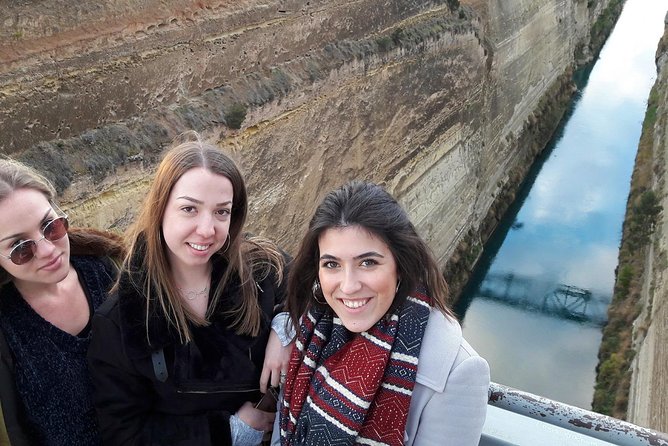
You start with the Corinth Canal, the dramatic man-made waterway linking the Aegean and Ionian seas and slicing through the Peloponnese. It is the rare stop that is both scenic and quick, and it sets the tone for the day.
Here is what you can expect: a chance to photograph the canal from a high viewpoint (up to about 80 meters), plus a walk across a pedestrian bridge. You can also get the big engineering facts, including that more than 2,500 workers dug it over about 12 years, between 1881 and 1893, creating a canal roughly 6.4 kilometers long.
The visit window is short, about 15 minutes, so treat this as a photo and orientation stop. I recommend quick shots first, then spend a minute just looking, because the canal is one of those places where photos never quite capture the scale of the cut.
Sparta in real life: Lycurgus, society, and what survives
Sparta is one of those destinations where your expectations need a small reset. The surviving remains are not Athens-level monumental, but the payoff is in understanding how Sparta organized life around military training.
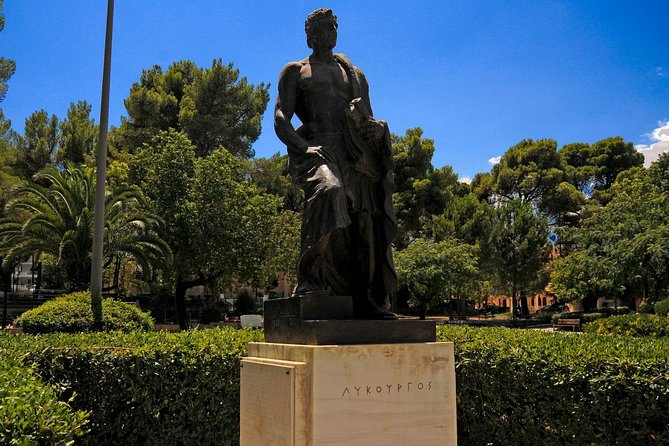
You get about 30 minutes at the Sparta stop focused on the system often associated with the figure of Lycurgus and the social categories that structured everything. Spartiates were Spartan citizens with full rights, mothakes were non-Spartan free men raised as Spartans, perioikoi were free residents who worked in commerce, and helots were state-owned serfs, essentially an enslaved local population.
What I like about this approach is that it gives you a mental map before you walk into the ruins. If you know what each group was, you interpret the site differently, not as random stones but as a society built to produce soldiers.
A small consideration: with only about half an hour here, you will not see everything. Think of this stop as the storytelling ignition, not the main event.
The Sparta museum and the Roman-era theater view
Next comes the Archaeological Museum of Sparta, usually a solid “pause and absorb” moment. It is an older provincial museum in a neoclassical building built in the mid-1870s, and it is your chance to connect artifacts to the social system you heard about earlier.
The ticket is extra and is listed as 10 for general entry, with seasonal pricing also described as 5 in winter and 10 in summer. The museum is also closed on Tuesdays, so if you are planning a Tuesday, you will want to swap your order in advance or be ready for a different emphasis that day.
Then you move to the Sparta Acropolis and Ancient Theater, about 1 hour. Even if the remains are eroded, the setting does work: local white marble from the Roman period, and a theater dated to the late first-century BC. In its prime it was thought to hold around 16,000 people, and it had a mobile stage. Much of the auditorium was damaged during the Byzantine period, and the surviving blocks show erosion over time.
This is one of the best stops for atmosphere because you can still imagine how sound and staging would have traveled across the space. It is also a good “slow down” stop if you enjoy standing, looking, and picturing the original use.
More day trips out of Athens:
- From Athens: Hydra, Poros, and Aegina Day Cruise with Lunch
★ 4.1 · 4,305 reviews - Cape Sounion and Temple of Poseidon Half-Day Small-Group Tour from Athens
★ 4.5 · 3,205 reviews - From Athens: Delphi Full Day V.R. Audio Guided Tour
★ 4.6 · 3,028 reviews - From Athens: Small-Group Mycenae, Epidaurus & Nafplio Trip
★ 4.8 · 2,805 reviews
Leonidas Monument: short stop, strong symbolism
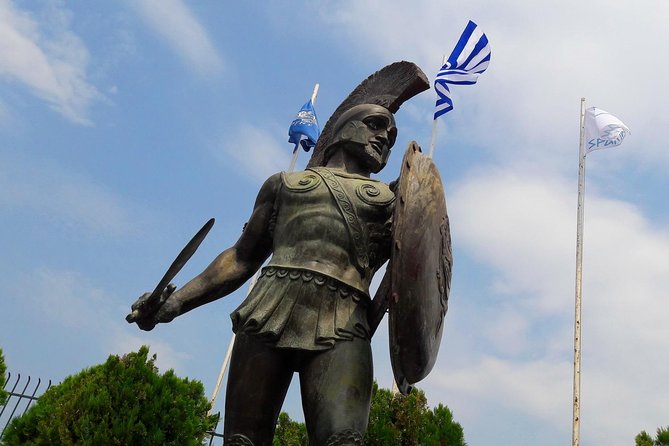
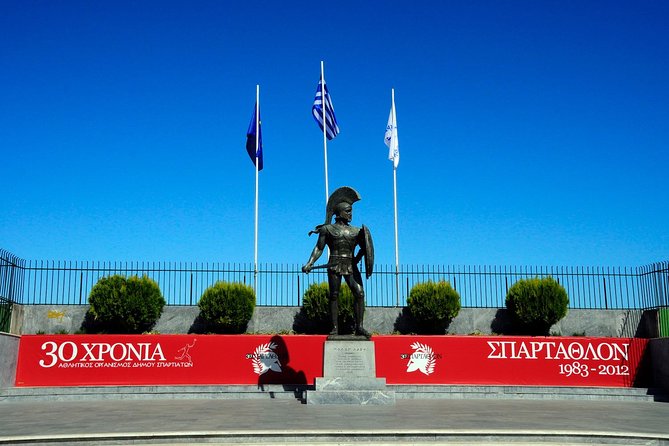
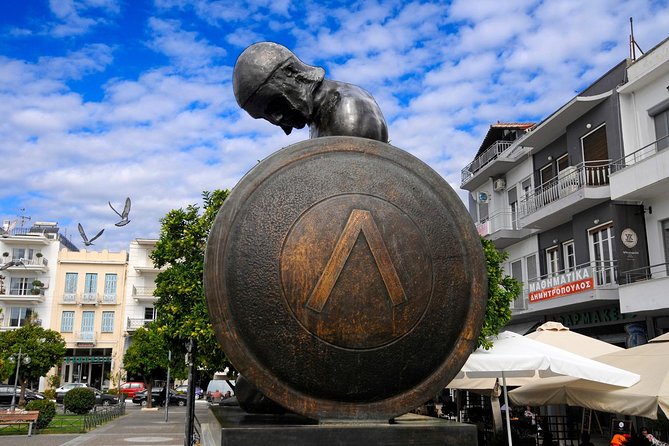
After the theater, you get a very brief but memorable moment at the Leonidas Monument, about 15 minutes. The statue faces a stadium area, and it is tied to the famous response associated with Thermopylae, the idea of come and get them.
Beyond the statue, the site is linked to archaeological remains from the 5th century BC, built from limestone. The monument is believed by some accounts to be connected to the tomb of Leonidas, and there is mention that the remains were transferred and buried here after the battle. The important nuance is that the site’s exact use is not fully verified, so it helps to treat it as compelling tradition plus evidence, rather than a locked-in fact.
I think this is a worthwhile stop because it gives you a clean emotional hook. You do not need long time here to feel the point.
Olive and Olive Oil Museum: should you add the optional 20 minutes?
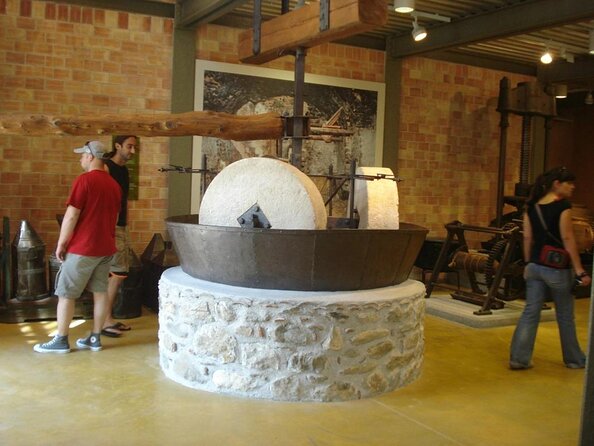
If you have time, the Olive and Greek Olive Oil Museum is a great way to break up the archaeological rhythm with something more specific and surprisingly science-forward. The museum is optional and typically runs about 20 minutes.
The ticket is extra, listed at 5, and it is closed every Tuesday. So if your day is a Tuesday, treat it as a no-go unless you have confirmed it is open.
What makes it interesting is the range of evidence it uses, from prehistoric to the early 20th century, with the story told through economy, nutrition, religious worship, art, and technology. You will see fossilized olive leaves reported as 50,000 to 60,000 years old from Santorini. You will also encounter Linear B tablets described as 14th century BC replicas, tied to early written references connected to olive and olive oil.
If you like food history or want a break from ruins, this is worth it. If you prefer “more stones, less explanation,” you might skip it and put that time into Ancient Corinth instead.
Ancient Corinth: your final anchor, plus the Saint Paul connection
Ancient Corinth is the big historical finish. You get about 1 hour and 10 minutes here, plus a second museum component that is described as included with the combined ticket.
Corinth is tied to the New Testament through two letters of Saint Paul, and it is also referenced in Acts as part of his missionary travels. Even if you are not religious, that context helps you understand why people cared about the city.
Tickets are extra and depend on season. The combined ticket for Ancient Corinth is listed as 15 in summer and 8 in winter, and it includes the museum as part of that entry. In winter time, the Archaeological Museum of Corinth is noted as closed on Tuesday, so again, day-of-week matters.
What I like about this part of the tour is that it is not only about one moment in time. Ancient Corinth was a major city, and walking through it gives you a sense of layered urban life. With the time you have, you will not see every corner, so aim for the most visible stretches and let your driver help you prioritize.
How the private driver makes the day feel human

This is a private tour, so the real magic is not the list of stops, it is the way the day runs. Your driver handles the air-conditioned vehicle, the route, and the logistics like fuels, toll roads, and parking fees.
The driver is also your historian-in-motion, using English narration and documentary style audio with historical details while you travel. In practice, this is where you get the best learning per minute.
The reviews highlight drivers who go beyond “read the brochure,” like Christos, Nikolaos, Takis, and Makis, who all bring friendly, practical explanations and help find good photo spots. One common theme: they make time feel respectful, answering questions and adjusting pacing so you are not dragged through places like a checklist.
Important limitation to know: the driver is not an archaeologist guide for walking through sites or museums. If you want an archaeologist to guide you inside, you would need to hire one additionally. For most visitors, the driver plus on-site explanations is enough, but if you are the kind of person who likes deep artifact interpretation, it is worth asking in advance.
Price and value: what $265.50 covers, and what to budget for tickets
The published price is 265.50 per person for a 10 hour private day. What you are really paying for is convenience plus control: pickup and drop-off from Athens center up to 7 km, a private air-conditioned vehicle, and a professional English speaking driver with informative audio as you travel.
Admissions are not included, and you should budget for them. The Olive and Olive Oil Museum is 5 if you add it. The Archaeological Museum of Sparta is season-dependent (winter 5, summer 10), and it is closed on Tuesdays. Ancient Corinth also changes by season, winter 8 and summer 15, and that ticket includes the museum.
So your “all-in” total typically depends on season and whether you add the olive museum. In summer, adding both museum options could push your total admission spend to roughly the low 30s per person, while in winter it is more like the mid teens to low 20s, depending on what is open that day.
Is it good value? Yes, if you want one-day coverage with zero public-transport stress and a driver who helps you interpret what you are seeing. If you are comfortable self-driving and you want to spend more time at fewer places, you might be able to shave costs, but you would lose the convenience and the guided travel narration.
Practical tips to make the day smoother
Plan for a long day. This is about 10 hours, so start with comfort in mind and bring layers, even in warmer months, because vehicles and shaded ruins can swing temperatures.
Use your first photo stops wisely. At the Corinth Canal, you have only about 15 minutes, so grab the best angles early, then just enjoy the scale.
For museums, check the Tuesday issue. The Sparta Archaeological Museum is closed on Tuesdays, the Olive Oil Museum is closed on Tuesdays, and the Corinth museum notes Tuesday closures in winter time. If your trip lands on a Tuesday, you will still see plenty of outdoor sites, but you may want to adjust your expectations about indoor time.
Wear shoes for walking on uneven ground, especially around ancient sites where surfaces can be rough. Bring water and consider a light snack for the drive, since you will be moving between stops.
Finally, choose your pace. One of the best perks of a private tour is the ability to linger when something grabs your attention. If your driver suggests a brief side stop near Sparta, it can be a nice add-on if time allows.
Should you book this Sparta and Ancient Corinth private tour?
I think you should book if you want a high-efficiency one-day route that combines engineering spectacle, Spartan social structure, and Ancient Corinth all with private pickup and a driver who tells the story as you travel.
It is especially worth it if you value convenience over DIY planning, and if you like having someone help you prioritize when the day is packed. If you strongly prefer deep museum study with an expert archaeologist in the galleries, you might want to consider adding an archaeologist guide or using this as the transport and storytelling backbone.
If your travel date is a Tuesday, go in with your eyes open about museum closures, then lean into the outdoor sites and the main walking stops.
If you want a single, well-run day that covers the Peloponnese classics without the hassle, this is a very reasonable choice.
FAQ
How long is the Sparta and Ancient Corinth private tour?
The tour runs about 10 hours.
What is included in the tour price?
The price includes air-conditioned transportation, private transport costs like fuels, toll roads, and parking, pickup and drop-off from your Athens location (within the stated area), and a professional English speaking driver with informative documentary style audio.
Are entrance fees included?
No. Admission fees are not included. You will pay extra for the Olive and Greek Olive Oil Museum if you choose it, the Archaeological Museum of Sparta, and the tickets for Ancient Corinth, with seasonal pricing.
How much are the tickets for Ancient Corinth?
Ancient Corinth’s combined ticket is listed as 15 in summer and 8 in winter, and it includes the museum.
Which museums close on Tuesdays?
The Archaeological Museum of Sparta is closed on Tuesdays. The Olive and Greek Olive Oil Museum is closed every Tuesday. The Archaeological Museum of Corinth is described as closed on Tuesday in winter time.
Is the Olive and Olive Oil Museum included?
It is optional. You can add it depending on time, and it has an extra ticket fee. It is closed on Tuesdays.
Does the driver provide expert museum guiding inside the sites?
The driver is not an archaeologist guide to accompany you during museum walks. If you want an archaeologist guide, you need to hire one additionally.
Where does pickup and drop-off happen in Athens?
Pickup and drop-off are offered from/to hotels or apartments in Athens center up to 7 km, at the arranged time.
Can I extend the tour if I want more time?
Yes. If you extend beyond the agreed hours, there is an additional charge per extra hour, with different rates depending on vehicle type.
Freshly listed near Athens
- Athens: Premium Guided E-Scooter Tour in Acropolis Area★ 5.0 · 133 reviews
- Ceramic and Pottery Creative Workshop with Two Local Artists★ 4.0 · 57 reviews
- Athens: Wine Workshop Create your Own Wine under the Acropolis★ 5.0 · 77 reviews
- Private Tour and Tasting at Zeginis Winery★ 5.0 · 18 reviews
- Athens: Greek Wines Tasting with Sommelier and Acropolis Views★ 5.0 · 88 reviews
- Private Day Trip to Nafplio from Athens★ 5.0 · 20 reviews
- Athens Old City Private Photoshoot Tour / 2 hrs★ 5.0 · 109 reviews
- Greek food and wine tasting★ 5.0 · 18 reviews
Ancient Corinth & Canal Day Trips, compared.
Ancient Corinth Day Trip with Canal & VR Guide
Read our review →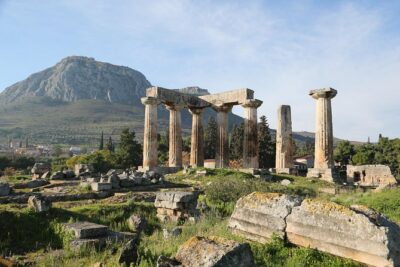
Private Biblical Tour Ancient Corinth & Isthmus Canal from Athens
Read our review →

Corinth Canal, Mycenae & Nafplio Premium Guided Tour
Read our review →
Private Tour of Apostle Paul’s Footsteps in Ancient Corinth
Read our review →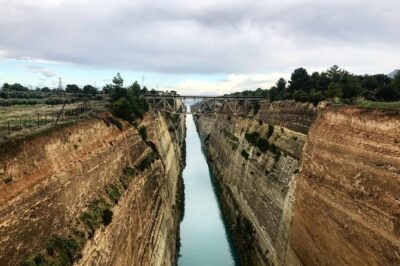
Corinth Half-Day Trip from Athens with Entrance Tickets
Read our review →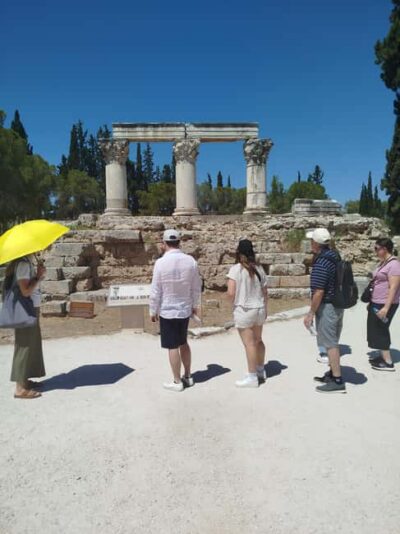
Ancient Corinth Tour with Official Guide & Tickets
Read our review →
Ancient Corinth, Epidaurus, Nafplio full day private tour from Athens
Read our review →Browse the lists this tour appears in