
Reviewed · SANTORINI TOURS & ACTIVITIES
Santorini: Experience Akrotiri with a Licensed Tour Guide
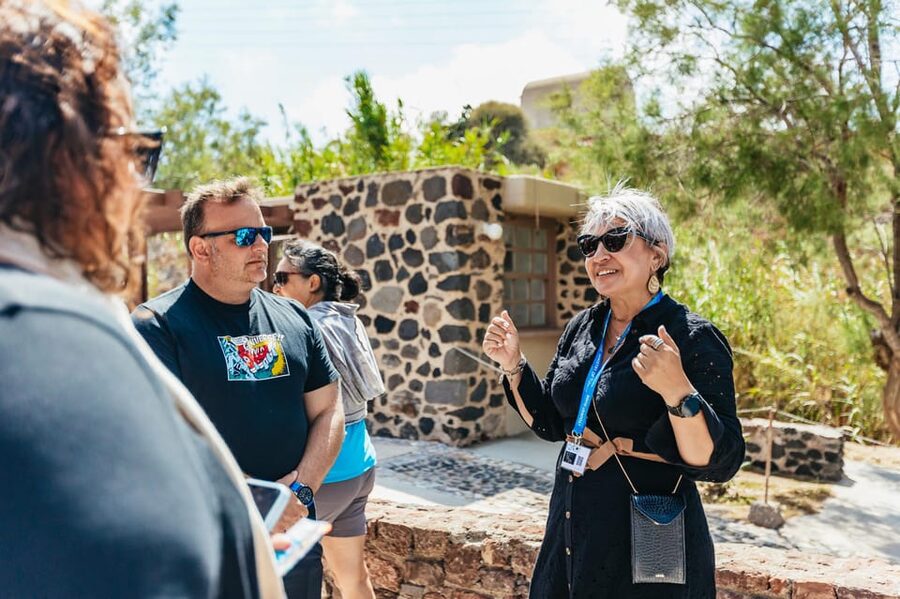
Akrotiri is a time machine in plain sight. A private guided walk here turns “ruins” into everyday life, from paved lanes to household spaces, led by Dima Georgia, a licensed English guide.
I especially love the chance to follow the site’s layout like it was a real neighborhood, including streets, squares, and drainage. And I like how Georgia explains what you are looking at, using photos of wall paintings that used to decorate the buildings.
The main drawback to plan for is simple: the tour does not include the archaeological entrance fee (€20 per person), so your total cost will be a bit higher than the tour price.
In This Review
- Key things that make this Akrotiri tour worth it
- Why Akrotiri hits harder with a guide
- Meeting at the entrance, then skipping the guesswork
- The paved streets and squares: reading a Bronze Age town
- Inside the multi-story buildings: kitchens, toilets, and drainage
- Wall paintings and the missing pieces: how photos bring life back
- How Atlantis talk fits, without taking over the visit
- Price and value for this private 75-minute experience
- Should you book the Akrotiri private guided tour?
- FAQ
- How long is the Akrotiri experience with the licensed guide?
- Where do I meet the guide?
- Is the entrance fee included in the tour price?
- Is this a private tour?
- What language is the tour delivered in?
- What should I bring, and what is not allowed?
- Is Akrotiri wheelchair accessible for this tour?
Key things that make this Akrotiri tour worth it
- A licensed private guide means you can ask questions and get direct answers as you walk
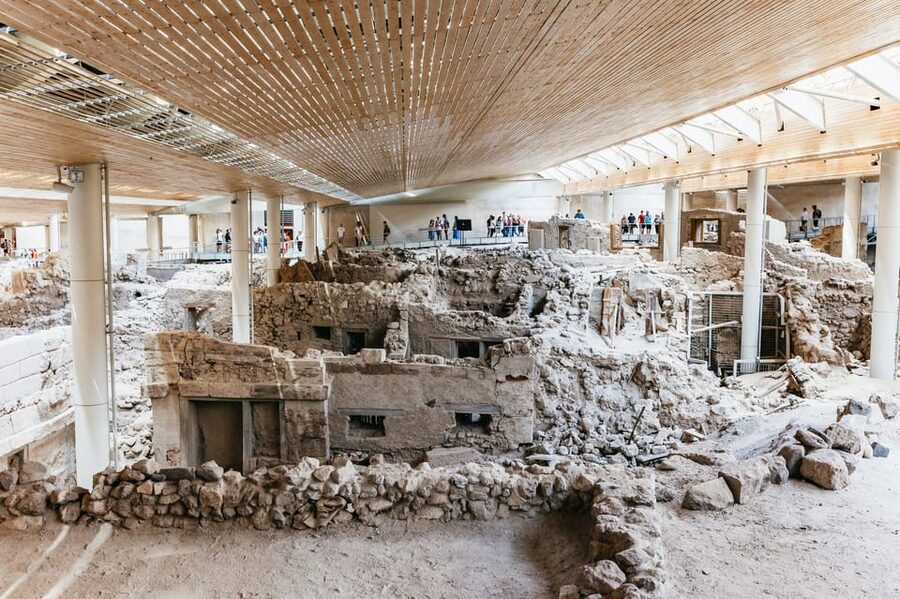
- Street-level layout at a well-preserved Bronze Age town, buried after an eruption around 1600 B.C.
- Everyday details you can actually see, like paved paths, multi-story building complexes, kitchens, and toilet facilities
- Wall-painting reconstructions shown via guide photos, so missing art still makes sense
- Urban planning and drainage become understandable, not just mentioned on signs
- The Atlantis theory connection is handled with archaeological context, not hype
Why Akrotiri hits harder with a guide
Akrotiri works as a wow site even if you arrive with zero background. The buried city is preserved in a way that lets you stand in something close to a snapshot of daily life. But without guidance, you risk seeing a collection of walls and trying to guess what they were.
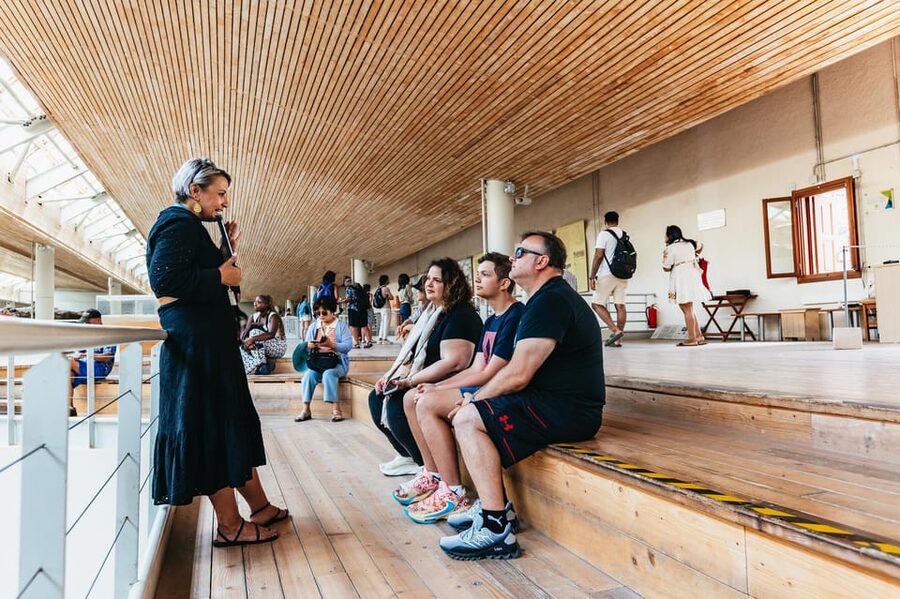
This is a 75-minute private tour, which is the right length for a concentrated visit. In that time, Georgia helps you connect the visible ruins to the big picture: how the settlement was organized, what kinds of buildings existed, and how people lived inside them. If you like “show me what this means,” you’ll feel the difference right away.
I also appreciate that the tone is practical, not academic-only. You walk the paved streets and squares, then you get the why behind the layout: why drainage mattered, what household spaces likely were, and how building height and layout affected everyday routines. It turns Akrotiri from a static stop into a place you can read.
One more plus: Georgia talks through competing theories, including the popular link people make to Atlantis myths. It is handled in a way that keeps you anchored to what archaeology can actually support, rather than getting lost in legend.
Other ways to spend the day near Santorini
- Santorini: Volcanic Islands Cruise with Hot Springs Visit
★ 4.4 · 10,869 reviews - Santorini: Catamaran Tour with BBQ Dinner, Drinks, and Music
★ 4.6 · 5,886 reviews - Premium Small-Group Catamaran Cruise with BBQ, Open Bar, Transfer
★ 5.0 · 4,209 reviews
Meeting at the entrance, then skipping the guesswork
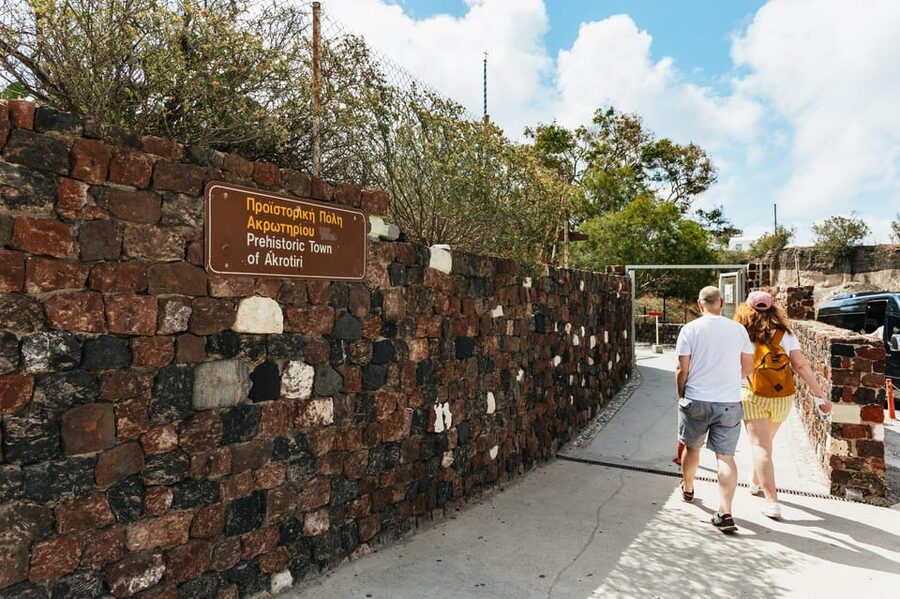
You meet the guide right at the entrance of the archaeological site, across from the cashier. That matters more than it sounds. Akrotiri can be confusing if you are trying to figure out tickets and where to start while also managing the heat and your own pace.
The tour is described as a private guided walking experience, so you are not stuck inside a rigid bus-group routine. You start, you follow the route, and Georgia keeps the story moving from one cluster of ruins to the next. The pacing is also flexible enough to stop for questions, which many history sites do not allow.
A big practical win here is that you should be able to skip the ticket line. That alone can save real time, especially if you hit a popular arrival window.
Bring a camera. Food and drinks are not allowed on site, so plan for a quick snack before you go and save water for after. If you want the best light for photos, early or later time slots often help, and some visitors have noted quieter moments when they had extra space around the ruins.
The paved streets and squares: reading a Bronze Age town
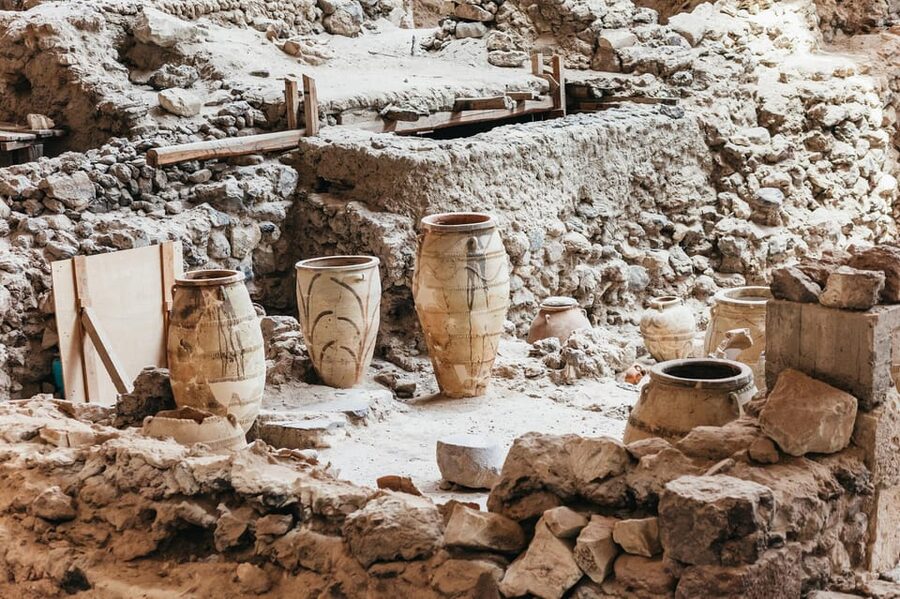
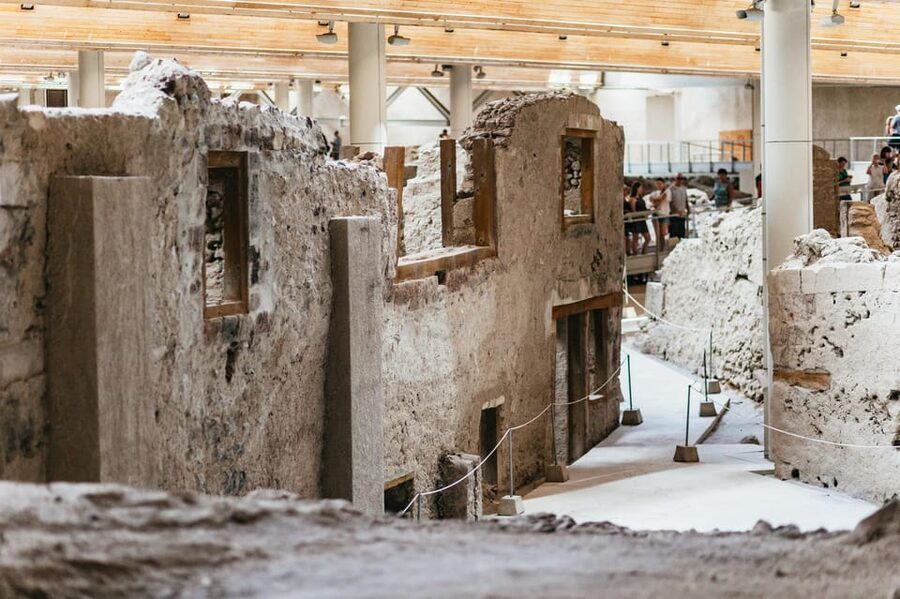
Once you are inside, you begin with the part your feet can understand fast. Akrotiri’s paved streets and the open squares give you a sense of how people moved and gathered. Georgia points out things you might otherwise miss, like how the layout hints at planning and how building placement shapes the neighborhood feel.
This is the core of the experience. You are stepping into a prehistoric city that was buried under volcanic ash after a strong eruption around 1600 B.C., and that burial is the reason so much remains. When you walk the stone paths, it is easier to imagine daily routines: moving between homes and shared spaces, dealing with passageways, and living within a compact settlement.
The best part of this guided approach is that it connects the visible to the functional. You are not just told that the town had order, you are shown where that order shows up in the streets, the squares, and the way buildings cluster together.
If you are a non-expert, you will still get something. The guide does not assume you know every term. If you are a history lover, you will likely get something too, because Georgia helps you interpret the site’s organization and what archaeologists think those structures were used for.
Inside the multi-story buildings: kitchens, toilets, and drainage
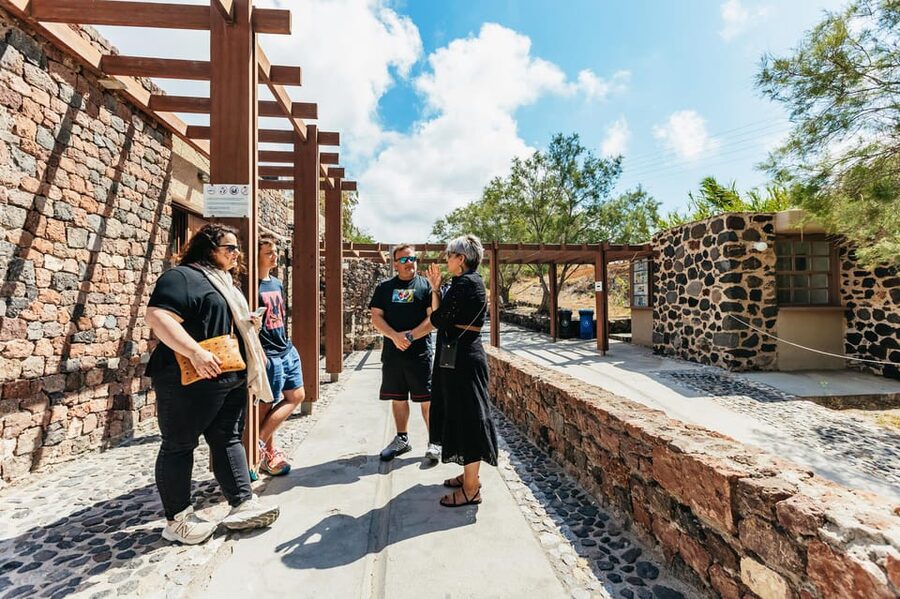
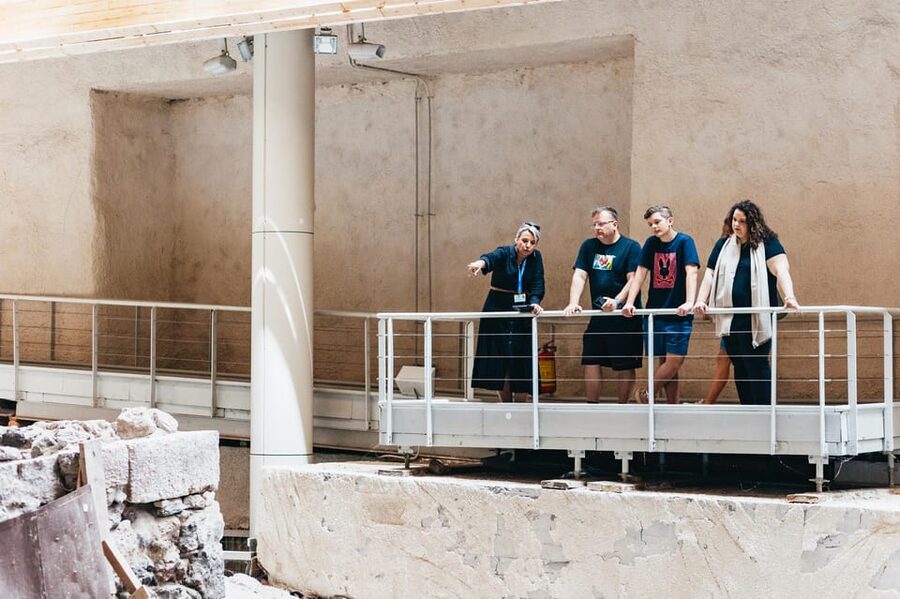
Akrotiri is sometimes summarized as a prehistoric wonder, but the real punch comes from the household details. You will walk past buildings that are described as 2 to 3 stories, and you will see preserved interior spaces like kitchens and toilet facilities.
That is the kind of evidence that makes the past feel real. It is also why people leave Akrotiri talking about everyday tech, like drainage and sanitation. One of the most memorable things here is how the site reflects practical engineering, not just impressive architecture.
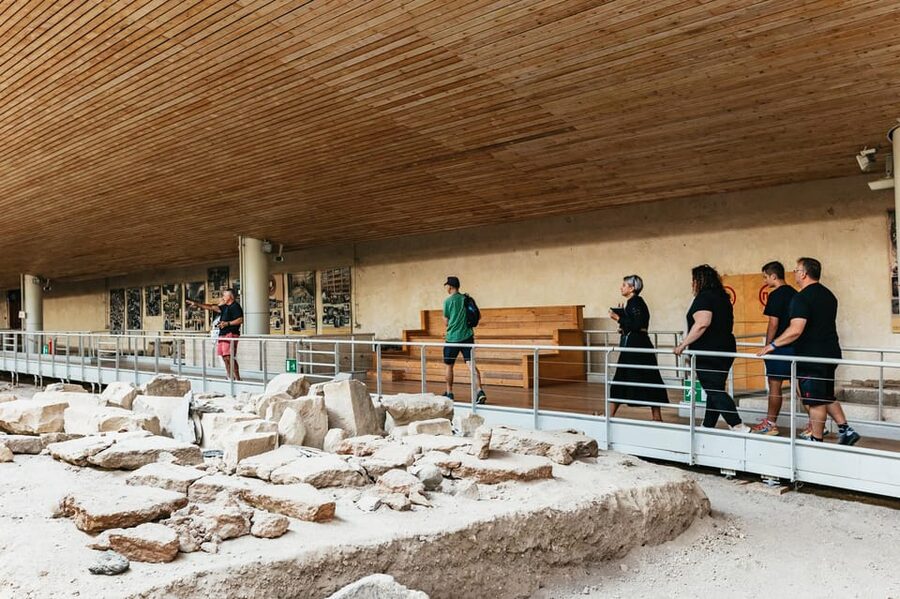
Georgia brings you through these spaces with context: what you are looking at, why it mattered, and how the settlement likely worked day to day. She may also share photos of what the walls looked like originally, which is crucial when pieces are missing or faded.
Here is how I’d think about it for your visit. Signs at archaeological sites are often written for quick reading, not real comprehension. A guide helps you slow down and connect clues. You start noticing relationships between rooms, between water management and building design, and between how the inside spaces would have functioned.
One small consideration: the tour is still time-limited. If you love to linger in one building complex and study it like a museum gallery, you might wish you had longer. But with a private group, Georgia can usually adjust questions and stopping points to match your interest.
A short hop away, these too:
- Santorini Classic Catamaran Cruise with BBQ, Drinks and Transfers
★ 5.0 · 3,933 reviews - Santorini: Luxury Catamaran Day Trip with Meal and Open Bar
★ 4.8 · 3,678 reviews - Half-Day Exclusive Catamaran Cruise in Santorini with Meal and Open Bar
★ 5.0 · 2,975 reviews - Santorini Gold Catamaran Cruise with Snorkel, BBQ & Open Bar
★ 4.8 · 2,822 reviews
Wall paintings and the missing pieces: how photos bring life back
Many people arrive expecting wall art to be what they focus on. Sometimes they are disappointed because ruins do not present paintings like a clean museum display. At Akrotiri, parts of the decoration are preserved, but not everything is visible in a straightforward way.
That is where Georgia’s method helps. She uses photos to show how wall paintings looked and where they fit into the original buildings. This gives you a fuller sense of the color, decoration, and interior vibe that you might not be able to reconstruct on your own.
You also benefit from the way she explains the likely purpose of spaces. Instead of you guessing, the guide frames the evidence: what excavators have found, what patterns suggest, and what is still under discussion. The point is not to overwhelm you with theory. The point is to help you interpret what you see while you are standing in front of it.
If you like having a simple takeaway, it is this: Akrotiri is not just ruins you walk past, it is a designed environment. The guide helps you see why the town looked and functioned the way it did, and why details like drainage and indoor facilities were part of normal life.
And yes, you can still take your own photos. But if you rely only on photos, you will miss the “what goes with what” connections that Georgia makes while you walk.
How Atlantis talk fits, without taking over the visit
A fun part of Akrotiri guided tours is the connection people make to the legend of Atlantis. This tour includes that thread, but the key is how it is handled.
Georgia discusses theories that connect Akrotiri with the Atlantis myth, while keeping the focus on archaeology and what the evidence can and cannot support. That balance matters. If you want myth as a side story, you get it. If you want the facts first, the guide keeps pulling you back to the site itself.
This is also one reason the private format is valuable. You can ask follow-up questions immediately, while the site is fresh in your mind. You can also tell the guide what you care about most, like architecture, daily life, or volcanic-ruin preservation.
If you are not a history enthusiast, this still lands. The Atlantis connection works as a narrative hook, and then the guide translates that hook into real details about the Bronze Age settlement.
Price and value for this private 75-minute experience
The tour price is $198 per group, up to 1 person, and it lasts about 75 minutes. Entrance is extra at €20 per person, and transfers are not included. So yes, it costs more than walking in on your own.
But here is the value angle I think matters. Akrotiri is a site where context changes everything. Without a guide, you can walk around and see interesting structures. With a guide, you understand what the structures likely were, how the town functioned, and what archaeologists infer from preserved layouts, rooms, and engineering features.
Also, you are getting a licensed English guide for a private stroll. The reviews for this experience consistently highlight how much visitors learn in a short time. You are paying for interpretation, not just for company.
One more practical value point: skip-the-line access and an easy meeting point reduce friction. If you are trying to squeeze several things into a Santorini day, that matters. Less time stuck in logistics means more time actually seeing and understanding.
I’d especially consider this if:
- you care about daily life details, not just famous monuments
- you want to ask questions without rushing
- you prefer a quieter visit where you can stop, look, and listen
Should you book the Akrotiri private guided tour?
Book it if you want Akrotiri to feel like a story you can follow, not a puzzle you solve alone. The combination of a licensed guide, a smart 75-minute structure, and clear explanations of household life, drainage, and built space is exactly what makes this experience satisfying.
Skip it only if you truly want a self-guided walk with minimal cost, and you are comfortable reading the site without much interpretation. If you are the type who likes to understand what you are looking at while you are looking at it, this is the safer bet for a memorable visit.
FAQ
How long is the Akrotiri experience with the licensed guide?
It lasts about 75 minutes (the guided tour portion is listed as 70 minutes).
Where do I meet the guide?
Meet your guide at the entrance of the archaeological site, across from the cashier.
Is the entrance fee included in the tour price?
No. The entrance fee is €20 per person and is not included.
Is this a private tour?
Yes, it is a private group experience.
What language is the tour delivered in?
The live tour guide is listed as English.
What should I bring, and what is not allowed?
Bring a camera. Food and drinks are not allowed.
Is Akrotiri wheelchair accessible for this tour?
Yes. The activity is listed as wheelchair accessible.
Freshly listed near Santorini
- Santorini: Top Sights Small-Group Tour with Local Guide★ 4.8 · 48 reviews
- Santorini: Private Guided Sightseeing Day Tour★ 4.9 · 103 reviews
- Santorini:All-inclusive Catamaran Cruise with Thirassia Stop★ 5.0 · 22 reviews
- Santorini Wine Roads: Tour of 3 Wineries with a Sommelier★ 4.8 · 79 reviews
- Santorini Volcano, Hot Springs Adventure★ 4.2 · 226 reviews
- From Santorini: Volcano Cruise With Oia Sunset★ 4.3 · 97 reviews
- Santorini: Wine Tour with Sunset in Oia★ 4.6 · 199 reviews
- From Thera: Thirasia Cruise w/ Volcano Hike and Hot Springs★ 4.3 · 67 reviews
Santorini Tours & Activities, compared.

Volcanic Islands Cruise with Hot Springs Visit
Read our review →
Catamaran Tour with BBQ Dinner, Drinks, and Music
Read our review →
Premium Small-Group Catamaran Cruise with BBQ, Open Bar, Transfer
Read our review →
Santorini Classic Catamaran Cruise with BBQ, Drinks and Transfers
Read our review →
Luxury Catamaran Day Trip with Meal and Open Bar
Read our review →
Half-Day Exclusive Catamaran Cruise in Santorini with Meal and Open Bar
Read our review →
Santorini Gold Catamaran Cruise with Snorkel, BBQ & Open Bar
Read our review →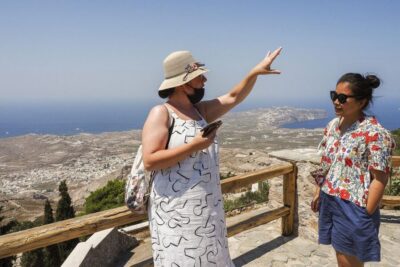
Top Sights Day Trip, Wine Tasting, & Oia Sunset
Read our review →Browse the lists this tour appears in