

Reviewed · AUDIO TOURS
Athens: Roman Agora E-Ticket and Audio Guide
Roman Agora is a small site with big stories. I like that this is a pre-booked e-ticket with a self-guided audio guide you can download before you go, so you are not stuck waiting or hunting for explanations. I also like the way the narration ties together everyday Roman-era life with the standout structures like the Gate of Athena Archegetis. The main drawback is simple, if you hate relying on your phone for orientation, this may feel a bit tricky.
For most people, the format works well: you can move at your own speed for about 45 minutes to 1 hour, using offline maps and narration. Just plan for your phone battery and storage, and bring headphones, because the audio setup is the whole show here.
In This Review
- Key things to know before you go
- A smart way to see the Roman Agora at your own pace
- Price and value: what $18 buys you
- Pre-download checklist: do this before you arrive in Athens
- Entering the Roman Agora: what your first minutes should feel like
- Gate of Athena Archegetis, Tower of the Winds, and the Mosque
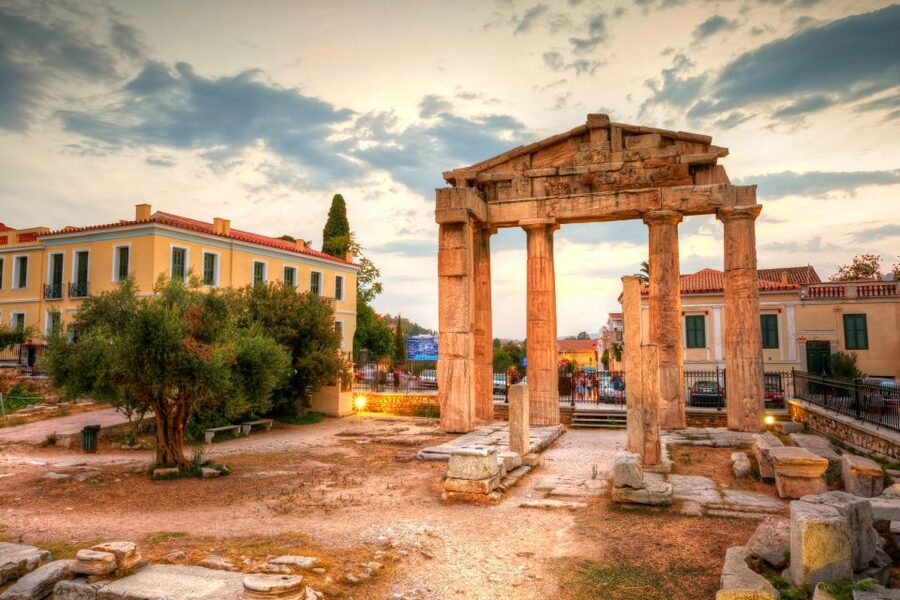
- Gate of Athena Archegetis
- Tower of the Winds
- Mosque
- The fountain house, Vespasianae, and shops you can actually picture
- Fountain house
- Vespasianae
- Shops
- Views over Athens and the route that ties it together
- What went well for others, and how you can copy the good parts
- Logistics you should not ignore (small details, big impact)
- Who should book this Roman Agora e-ticket and audio guide
- Should you book it?
- FAQ
- How long is the Roman Agora visit with this e-ticket and audio guide?
- What’s included in the ticket price?
- Do I need headphones?
- Can I download the audio tour before I arrive?
- Does the audio tour work offline?
- What languages are available?
- Is there a live guide included?
- What phone types are compatible?
- Is there a meeting point and how does entry work?
- Is this activity refundable?
Key things to know before you go

- E-ticket you receive by email, with an activation link for your tour
- Offline content, including text, audio narration, and maps to avoid roaming charges
- Must-see stops on your route, including the Tower of the Winds and the Mosque
- Audio in multiple languages, including English, Spanish, German, French, Italian, Greek
- Limited device compatibility, with no Windows phone support and some older Apple devices excluded
- Short visit window, roughly 45 minutes to 1 hour, ideal for fitting into a busy Athens day
A smart way to see the Roman Agora at your own pace
This is one of those Athens stops that feels compact, yet the stories make it expand. With a 45 minutes to 1 hour visit, you can knock it out between other sights without feeling rushed, and still get real context for what you are looking at.
I also like that it is not a group tour with a loud schedule. You get to choose your pace, pause when something catches your eye, and replay parts later if you want more detail while you keep wandering.
The big tradeoff: there is no live guide. That is fine if you enjoy audio storytelling and reading what you see, but it is not ideal if you need constant human interpretation or step-by-step guidance.
Other ways to spend the day near Athens
- Athens: Acropolis & up to 5 Archaeological Sites Combo Pass
★ 4.2 · 13,904 reviews - Athens: Acropolis, Parthenon & Acropolis Museum Guided Tour
★ 4.8 · 9,316 reviews - The Acropolis, Parthenon & Acropolis Museum Guided Tour
★ 4.7 · 8,493 reviews
Price and value: what $18 buys you
At $18 per person, you are paying for two things: an entry ticket that helps you avoid line friction, and the convenience of a smartphone audio tour that works even without data.
Is it worth it? For me, the “yes” hinges on your comfort with the format. If you will actually use the downloadable tour, it is good value because you get more than entry. If you are going to skip the audio or you are traveling with a phone that cannot handle the app, then you are paying for a ticket to a site that is already small and easy to cover quickly on foot.
Also note an important small-print reality: you must book per device, not per participant. If you are traveling as a group and only one phone has the tour loaded, you might end up disappointed unless you plan your devices in advance.
Pre-download checklist: do this before you arrive in Athens
This experience lives on your smartphone. Before you go, you will receive an email with instructions and an activation link, and you download the audio tour through the provider’s app.
Here is the practical checklist I would follow:
- Download the app and the tour while you still have reliable Wi-Fi
- Make sure you have 100 to 150 MB of free storage space
- Bring headphones (they are not included)
- Arrive with a charged phone, because you are using audio and offline maps
One detail that can save your day: if your email lands in spam, you can miss the activation link. Check your spam folder before you leave, so you are not scrambling once you are at the site.
Device compatibility matters too. The tour requires Android (5.0 and later) or iOS, and it is listed as incompatible with Windows phones and certain older Apple models (for example, iPhone 5/5C or older, iPod Touch 5th generation or older, iPad 4th generation or older, and iPad Mini 1st generation). If you are traveling with older hardware, double-check before booking.
Entering the Roman Agora: what your first minutes should feel like
After you arrive with your e-ticket, you start on your own. There is a skip-the-line service included, which helps keep the opening minutes smooth.
Then comes the key move: put on your headphones and follow the narration. The audio tour is designed to guide you through major features without turning the visit into a race. You will get the sense of time travel, not because the stones change, but because the stories connect the structures to what people likely did there.
This is also the moment to reset expectations. The site is not huge, so you will not “discover” it for hours like some sprawling archaeological parks. Instead, you will get a concentrated route, with the audio acting like the extra layers of interpretation.
A short hop away, these too:
- Athens: Cape Sounion & Poseidon Temple Sunset Half-Day Trip
★ 4.8 · 8,241 reviews - Acropolis: Premium Acropolis and Parthenon Guided Tour
★ 4.8 · 5,208 reviews - Athens: Mythology of Delphi, Museum and Arachova Guided Tour
★ 4.7 · 5,102 reviews - All Day Cruise -3 Islands to Agistri,Moni, Aegina with lunch and drinks included
★ 5.0 · 4,958 reviews
Gate of Athena Archegetis, Tower of the Winds, and the Mosque
These three landmarks sit at the heart of the experience, and they are named upfront for a reason. The narration gives you the link between each stop and the larger idea of classical Athens meeting Roman influence.
Gate of Athena Archegetis
You start with the Gate of Athena Archegetis. The audio framing matters here. You are not just looking at ruins, you are learning how the gate fits into the flow of everyday movement and power in the ancient city.
If you love architecture but also want human stories, this stop is a strong match. The audio uses short, original story-style explanations rather than long lectures, which keeps your attention during a self-guided walk.
Tower of the Winds
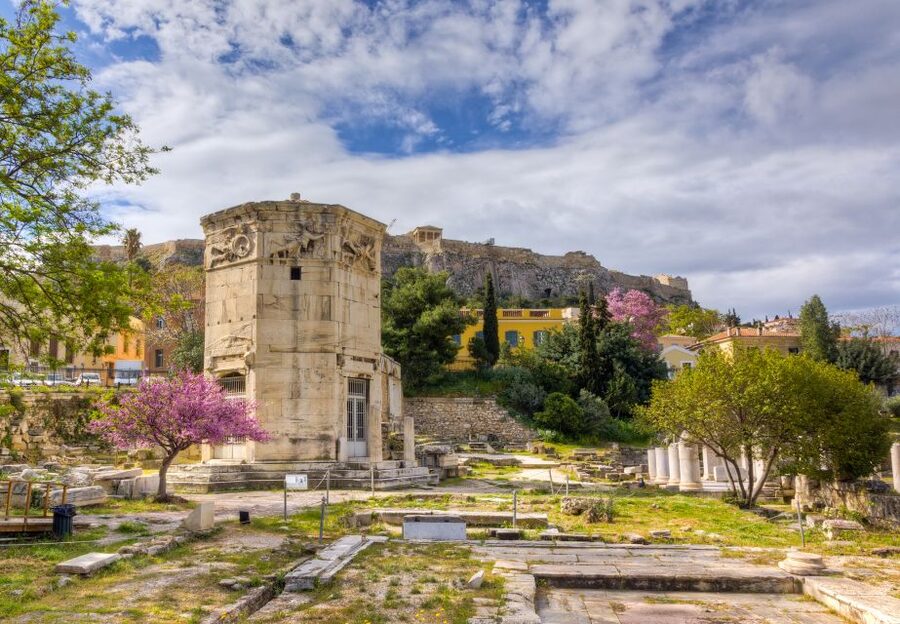
Next up, the Tower of the Winds gets its own moment. The value here is that you do not have to guess what you are seeing. The audio guide is intended to help you “meet the Winds,” meaning the storytelling anchors the tower to the theme of the site.
One practical note: because this is self-guided, the audio pacing is important. If you fall behind, you may have to rewind to re-sync with the route.
Mosque
Then you move to the Mosque. It is an essential contrast point because it shows the layered history of the space across different eras.
This is where audio tours really shine for me. Even without a live guide, the narration can help you read the site like a timeline instead of a collection of isolated monuments.
The fountain house, Vespasianae, and shops you can actually picture
After the headline landmarks, the audio shifts toward smaller, everyday elements. That is where the Roman Agora can feel especially rewarding, because it stops being purely monumental and starts feeling lived-in.
Fountain house
The fountain house is one of the places that helps you understand how people would have used the space. The narration aims to connect these everyday functions to the larger setting of the city, so you get more than scenery.
When the audio is functioning well, this kind of stop is exactly what makes archaeological sites click. You start imagining routines, not just admiring shapes.
Vespasianae
The Vespasianae are another clue that this was not an empty museum zone. The audio tour is designed to highlight uncommon anecdotes and historical context around these features, turning something you might otherwise overlook into a story you remember.
If you are the type who enjoys the practical side of history, this is a high-value section. It also helps balance the more dramatic structures like gates and towers.
Shops
The shops round out the “daily life” theme. You get the sense that this was a working part of the city, where people moved through routines rather than visiting a static landmark.
Even if you are not a history fanatic, shops are often the easiest part to grasp because you can relate them to how markets feel today, just in a very different time period.
Views over Athens and the route that ties it together

One highlight is the chance for a splendid view of the Acropolis. That matters because it pulls the Roman Agora out of isolation and reminds you how your sightseeing fits into the wider Athens geography.
The audio tour also encourages you to relate what you see to where you are standing. That is useful, because at a self-guided site you need your brain to stay oriented. When it works, you feel like you are walking through a story with a clear sense of direction.
One potential consideration from feedback: a small number of people found the audio difficult to follow for orientation. If you know you sometimes struggle with self-guided audio at archaeological sites, arrive with a calm mindset and give yourself extra time to read signage and check your bearings.
What went well for others, and how you can copy the good parts
Two themes show up in the overall feedback pattern for this experience.
First, many people praise the audio itself as engaging and effective at making the history feel present. That makes sense because the format is built around brief, original stories supported by offline maps and narration.
Second, the route feels easy to manage for short attention spans. One positive comment noted the visit time as worth it for the experience and said it was simple to buy a ticket on site as a backup, especially when the site felt quiet.
You can benefit from both by planning like this:
- Start promptly so you finish within your 45 minutes to 1 hour target
- Use the offline maps early, not halfway through
- If you are concerned about audio clarity, slow down at each named landmark and make sure you are in the right spot before moving on
Logistics you should not ignore (small details, big impact)
This activity is designed as a smartphone audio tour plus entry. There is no live guide, and the meeting point can vary depending on what option you booked, but you are ultimately entering and exploring on your own.
You should also plan for the audio being replayable. Since the content is downloadable offline, you can use it more than once and even listen before or after your visit.
Finally, keep in mind that the course of the visit may be modified and special restrictions can be imposed. Follow site guidelines when you arrive. Ancient sites can have changing conditions, and the audio route may adapt.
Who should book this Roman Agora e-ticket and audio guide
This is a great fit if:
- You want a self-paced Athens experience without the pressure of a group
- You enjoy learning through audio storytelling rather than a live lecture
- You will actually download offline content in advance
- You have a compatible Android or iOS smartphone and you are comfortable using headphones
It is less ideal if:
- You hate relying on your phone for navigation
- Your device is incompatible, or you are traveling with only one phone for multiple people and cannot cover the per-device requirement
- You were hoping for a live guide Q and A, because there is no live guide included
If your goal is a quick, high-impact stop that supports your broader Athens sightseeing, the Roman Agora is a smart choice. It is the kind of place where an audio guide can turn “stones” into a sense of ordinary life centuries ago.
Should you book it?
I would book this if you want structure without a group. The offline audio, the named stops like the Gate of Athena Archegetis and Tower of the Winds, and the ability to revisit the content later make the experience feel more complete than a bare entry ticket.
Skip it if you cannot or will not manage the tech. If downloading, storage, headphones, or device compatibility is a stressor, you may end up spending time troubleshooting instead of enjoying the site.
If you do book, give yourself a small buffer before you start. Check your email, download the tour, and arrive ready to press play. For a short Athens window, this is a practical way to see the Roman Agora with real context, not guesswork.
FAQ
How long is the Roman Agora visit with this e-ticket and audio guide?
The duration is listed as 45 minutes to 1 hour, depending on availability and starting times.
What’s included in the ticket price?
You get an adult entry ticket to the Roman Agora, a skip-the-line service, and a self-guided audio tour on your smartphone in multiple languages, including offline content (text, audio narration, and maps).
Do I need headphones?
Yes. Smartphone or headphones are not included, so you should bring headphones.
Can I download the audio tour before I arrive?
Yes. You receive an email with instructions and an activation link, and you should download the app and audio tour on your phone prior to your visit.
Does the audio tour work offline?
Yes. It includes offline content such as text, audio narration, and maps, designed to help you avoid roaming charges.
What languages are available?
The audio tour is available in English, Spanish, German, French, Italian, and Greek.
Is there a live guide included?
No. This is a self-guided experience, and there is no live guide.
What phone types are compatible?
The tour requires Android (version 5.0 and later) or iOS, and it is listed as incompatible with Windows phones and certain older Apple devices (including iPhone 5/5C or older and older iPod Touch and iPad models listed in the important info).
Is there a meeting point and how does entry work?
There is no live guide and no specific meeting point provided in the activity details. The meeting point may vary depending on the option booked, but you should plan to enter and explore independently with your e-ticket.
Is this activity refundable?
No. The activity is listed as non-refundable.
Freshly listed near Athens
- Private Guided Tour: Athens, Acropolis and Acropolis Museum★ 4.9 · 62 reviews
- Private Athens Tour with a Local- Highlights & Hidden Gems★ 4.9 · 64 reviews
- Athens: Private Acropolis Tour with focus on Kids & Families★ 4.8 · 51 reviews
- Piraeus Port: Acropolis Museum and Parthenon Mythology Tour★ 3.7 · 29 reviews
- Poros Island: Full Day Trip From Athens with Swimming★ 4.8 · 33 reviews
- Athens: Ouzo Tasting at Brettos Plaka★ 4.3 · 32 reviews
- Athens Old Town: Greek Olive Oil & Herbs Tasting★ 4.2 · 41 reviews
- No Diet Club – Unique local Food Tour in Athens!★ 4.9 · 38 reviews
Audio Tours, compared.

Acropolis Ticket with Optional Audio or Live Guide
Read our review →
Cape Sounio & Poseidon Temple Trip with Audio Guide
Read our review →

Acropolis Museum Ticket with optional Audio Guide
Read our review →
Acropolis Ticket & Optional Self-Guided Audio Tours
Read our review →
Knossos Palace Entry Ticket with Optional Audio Guide
Read our review →
Browse the lists this tour appears in