
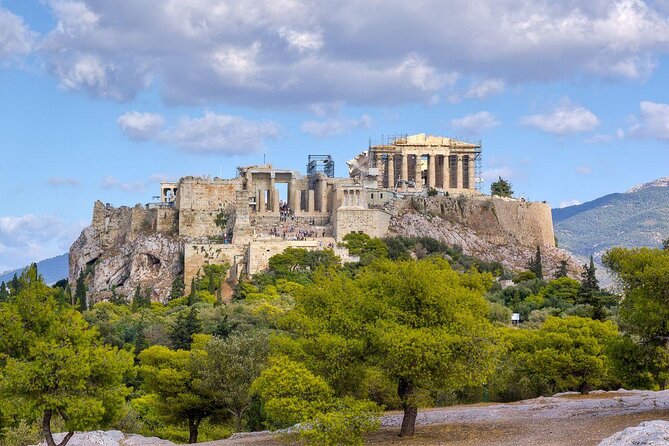
Reviewed · ACROPOLIS TICKETS & GUIDED TOURS
Athens Half-Day Tour: Acropolis, Parthenon & All Major Landmarks
Athens feels different when you move with purpose. This private half-day packs the Acropolis and Parthenon into a smart schedule, then sweeps you through the city’s biggest landmarks with a calm, air-conditioned ride. I especially liked the hotel pickup and drop-off that takes the hassle out of getting around, and the fact that your driver offers history context while still letting you explore at your own pace. The main drawback to plan for is that entrance tickets for key sites cost extra, and the driver cannot accompany you inside museums or archaeological areas.
This is also a good match if you want variety without committing to a full day. You’ll get front-door service, bottled water, and English-language commentary as you travel, plus the freedom to spend a little more or less time depending on your energy and the heat.
In This Review
- Quick hits
- Door-to-door convenience, private van, and why it changes everything
- Acropolis and Parthenon: how to make a 5-hour plan actually feel complete
- What to expect on-site
- A practical tip
- Plaka and the Alexander the Great connection: history you can walk into
- Roman Athens in one sweep: Hadrian’s Arch and Olympian Zeus
- Panathenaic Stadium, Parliament, and the Monument to the Unknown Soldier
- The Athenian Trilogy: a fast, elegant walk through education and culture
- Lycabettus Hill and the modern Athens rhythm: Dromeas and the Marathon Run
- Optional upgrades that make this feel less rushed
- Acropolis Museum (upgrade)
- Ancient Agora of Athens (upgrade)
- Which upgrade fits you?
- Price and what you actually pay for at $145.12 per person
- Is it good value?
- Who should book this Athens half-day tour, and who should pick something else
- Should you book it?
- FAQ
- Are entrance tickets included for the Acropolis and other sites?
- How long is the tour?
- Is hotel pickup and drop-off included?
- Is this a private tour?
- What language is the driver?
- Are there optional add-ons?
Quick hits

- Private, only your group so you are not squeezed into a large tour rhythm.
- Door-to-door pickup and drop-off that saves you time in a busy city center.
- Driver-led history framing, then you explore at each site (tickets are not included).
- Acropolis and Parthenon views with timed stops to avoid feeling rushed.
- Lots of major landmarks with many free entrances, including Hadrian’s Arch, Parliament, and the Temple of Olympian Zeus.
- Optional upgrades for the Acropolis Museum or the Ancient Agora if you want more depth.
Door-to-door convenience, private van, and why it changes everything
Athens rewards planning. This tour starts with hotel pickup and drop-off, so you spend your limited time actually seeing Athens, not negotiating buses or taxis. Your driver arrives about 5 minutes before your set start time, and you can share your location details during booking (airport pickup costs extra).
Once you are in the vehicle, it is built for comfort, not sightseeing fatigue. Expect an air-conditioned car or van, WiFi on board, and bottled water, which sounds small until you realize how quickly the afternoon heat builds up around the major sites. In multiple experiences, drivers like Petros, Stavros, and Panos are specifically praised for staying on time and keeping things organized so you do not feel dragged from one stop to another.
One more detail that matters: the driver is not an official guide allowed to walk inside the archaeological sites and museums with you. That means you should think of this as “guided context plus smart navigation,” not a full-on live walkthrough in every room.
More Acropolis entries and guided walks:
- Athens: Acropolis & up to 5 Archaeological Sites Combo Pass
★ 4.2 · 13,904 reviews - Athens: Acropolis, Parthenon & Acropolis Museum Guided Tour
★ 4.8 · 9,316 reviews - The Acropolis, Parthenon & Acropolis Museum Guided Tour
★ 4.7 · 8,493 reviews
Acropolis and Parthenon: how to make a 5-hour plan actually feel complete
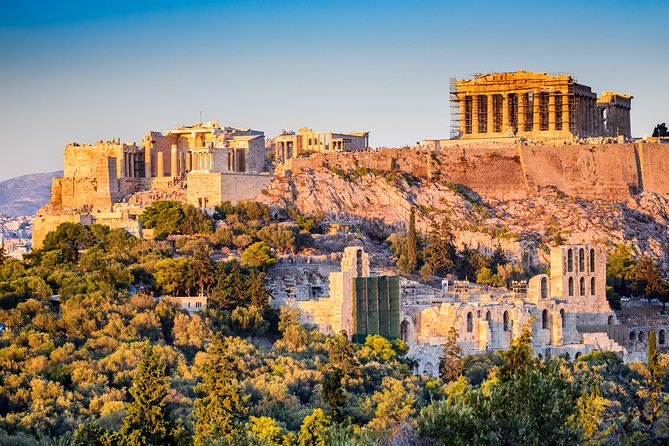
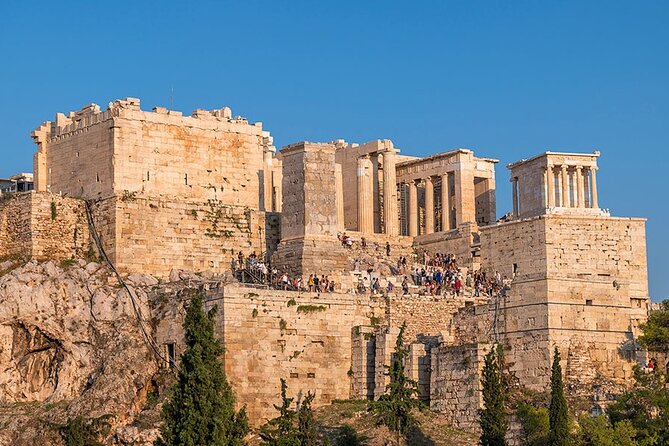
The Acropolis is the headline, and the timing is designed for first-time visitors. You start with a stop at the Acropolis, where you get time to take in the Propylaea, the Erechtheion, and the Temple of Athena Nike, all set against the kind of city views that are hard to reproduce elsewhere. Admission to the Acropolis Hill costs extra, and the tour experience itself does not include the ticket.
Then you focus on the Parthenon itself. The Parthenon was dedicated to Athena and dates to the Classical period (447 to 432 BCE), built in Pentelic marble and defined by its Doric columns and carved friezes. You get a dedicated stop so you can see the proportions up close and also step back for the classic wide-angle perspective.
What to expect on-site
- Time is limited on purpose, so you will likely concentrate on the big monuments and the best viewpoints rather than trying to cover every corner.
- Queues happen, especially at peak hours, so plan for waiting time even with a reserved approach.
- You will be able to ask your driver for practical “where to go next” guidance before you head in, then you move through the site on your own.
A practical tip
If you want the smoothest start, pre-order your Acropolis tickets a few days before you arrive using hhticket.gr, since those tickets can be tricky to obtain last minute. Even if you arrive with everything sorted, give yourself a little extra patience for lines, because the Acropolis is, well, the Acropolis.
Other ways to spend the day near Athens
- Athens: Cape Sounion & Poseidon Temple Sunset Half-Day Trip
★ 4.8 · 8,241 reviews - Acropolis: Premium Acropolis and Parthenon Guided Tour
★ 4.8 · 5,208 reviews - Athens: Mythology of Delphi, Museum and Arachova Guided Tour
★ 4.7 · 5,102 reviews - All Day Cruise -3 Islands to Agistri,Moni, Aegina with lunch and drinks included
★ 5.0 · 4,958 reviews
Plaka and the Alexander the Great connection: history you can walk into
After the high drama of the hill, the tour drops you into Athens at street level. Plaka is the neighborhood under the Acropolis, famous for winding alleys, neoclassical facades, tavernas, cafes, and the feeling that you are walking through old layers of the city. This is not about collecting ruins like postcards. It is about getting your bearings, finding a good snack, and feeling the neighborhood rhythm.
Then you hit a stop tied to Alexander the Great. You get the key background: born in 356 BCE, ascending to the Macedonian throne at 20 after Philip II’s death, and launching campaigns that shaped one of the largest empires in history. The story is not just military trivia. It also explains why Athens sits at the crossroads of Greek and wider Mediterranean culture.
If you like history that explains why places matter, this segment helps you connect the monuments you just saw to the people who shaped later eras.
Roman Athens in one sweep: Hadrian’s Arch and Olympian Zeus

Athens did not stop at Classical Greece. The tour quickly shifts gears into the Roman chapter.
First is Hadrian’s Arch, built in 131 AD. It is about an 18-meter-tall gateway in Pentelic marble, with inscriptions that reference Theseus on one side and Hadrian on the other. It marks a boundary idea, between the old city and the new city, so it is a great “how Athens changed” stop. Entry is free, so it is easy to enjoy even with tight timing.
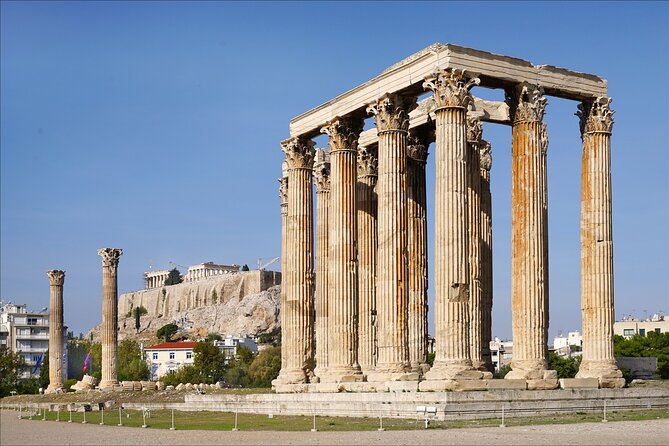
Next comes the Temple of Olympian Zeus, a massive project that took centuries to finish. You can still sense the original ambition even though only a few columns and ruins remain. The temple was connected to Zeus and included a colossal chryselephantine statue in its prime. Today, it is mostly scale, atmosphere, and the chance to see Corinthian columns rising as a ruin, which is a different kind of wow from the crisp Parthenon.
This section works well because it does not demand long museum time. You get visual impact with short walking, and you keep moving while your legs are still fresh.
Panathenaic Stadium, Parliament, and the Monument to the Unknown Soldier
A nice trick of this tour is that it balances stone monuments with what Athens does right now. You are not stuck in the past only.
Panathenaic Stadium is next, also known as Kallimarmaro. It is famous for being made entirely of white marble and for hosting the Panathenaic Games in ancient times. It also has Olympic legacy because the modern Olympic Games reopened the stadium in 1896. The ticket for the stadium is not included, but the stop itself is brief enough to still feel satisfying.
Then the tour lands at Syntagma Square, where you visit the Hellenic Parliament. The building is a neoclassical structure originally built as a royal palace in 1843, and Parliament has been there since 1934. The Tomb of the Unknown Soldier sits right there, guarded by the Evzones in traditional uniform. There is also an eternal flame and a sense of ceremony that makes the stop feel more than just a quick photo break.
If your timing lines up with the guard ceremony, it is a memorable window into national identity. Even if you do not catch it perfectly, the arrangement of monuments and the ongoing activity around Syntagma make it feel alive.
The Athenian Trilogy: a fast, elegant walk through education and culture
One of my favorite parts of this style of city tour is when it shifts from ruins to institutions. The tour includes a look at the Academy of Athens, the National and Kapodistrian University of Athens, and the National Library of Greece.
These are part of the so-called Athenian Trilogy, and they are best seen with a little context. The Academy was founded in 1926 and takes inspiration from Plato’s older academy, with a grand neoclassical facade and statues of Athena and Apollo. The university, founded in 1837, is Greece’s oldest and largest, and its historic main building ties into that same architecture group. The National Library, founded in 1832, is associated with Theophil Hansen and is a key place for preserving Greek manuscripts and rare collections, with modern facilities too.
Here is why it works on a half-day: you get the feel of “serious Athens,” the city that builds knowledge and keeps records, not just the city that preserves monuments.
Most of these entrances are free, and the stops are short, so you do not lose time hunting for ticket lines.
Lycabettus Hill and the modern Athens rhythm: Dromeas and the Marathon Run
The tour includes Mount Lycabettus for a short, practical break. The hill is about 300 meters above the city and offers panoramic views. At the top you find the Chapel of St. George, and there is even a legend that connects Athena to the hill’s formation. The stop is brief and entry is free, so think of it as a viewpoint reset rather than a full hike.
Then you also encounter the modern side of the city’s storytelling through sculpture and sport. Dromeas (The Runner) is a modern work by Costas Varotsos from 1994, built from layered glass and iron to show movement and speed. Nearby, you see the idea of the Marathon Run, tied to Pheidippides’ legendary run from Marathon to Athens in 490 BCE, which later inspired the modern marathon tradition in the Olympics.
This pairing is useful because it connects the ancient theme of endurance to the way Athens commemorates it today. If you are the type who likes Athens to make sense as one continuous thread, these stops give you that continuity in just a few minutes.
Optional upgrades that make this feel less rushed

The base tour is designed to hit the big icons and the biggest landmarks. If you want more time with the artifacts and the urban layout behind the ruins, you can add options.
Acropolis Museum (upgrade)
The Acropolis Museum is a modern building opened in 2009, positioned at the foot of the hill with views toward the Parthenon. Inside, the big advantage is clarity. You get over 4,000 artifacts across five floors covering Archaic, Classical, and Roman periods.
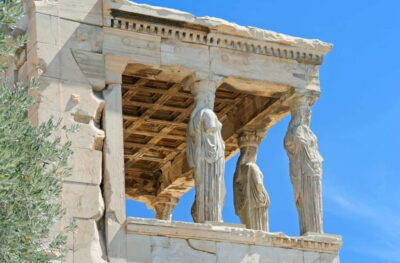
The highlight is the Parthenon Gallery, designed with glass walls that keep a sightline to the Parthenon outside. You can also see the Caryatids, the original statues from the Erechtheion. The building design even includes glass sections in the floor, showing ancient ruins beneath. Tickets are not included, and the museum option adds about one hour.
Ancient Agora of Athens (upgrade)
The Ancient Agora upgrade is ideal if you want Athens beyond temples. This was the city’s social, political, and commercial center starting from the 6th century BCE. You can see major spaces like the Stoa of Attalos (a covered colonnade used for shopping and gatherings) and the Bouleuterion, where the city council met.
This area is also tied to philosophy, including the idea that thinkers like Socrates frequented the Agora. It helps you understand that ancient Athens was not only about monuments. It was about civic life and debate. Like the museum, the Agora admission is not included, and the stop adds about one hour.
Which upgrade fits you?
- Choose Acropolis Museum if you want artifacts explained and displayed in a modern, easy-to-understand way.
- Choose Ancient Agora if you care about how people lived and governed, not only how temples looked.
Price and what you actually pay for at $145.12 per person
At $145.12 per person for about 5 hours, the price has a clear logic. You are paying for private, door-to-door transportation plus an English-speaking driver who provides history context while you travel between sites.
What you are not paying for is the cost of entering the sites. Entrance fees are extra, including:
- Acropolis Hill admission at €30 per person
- Acropolis Museum admission at €20 per person (optional)
- Ancient Agora admission at €20 per person (optional)
Other key stops are free to enter, like Hadrian’s Arch, the area around Hellenic Parliament, the Temple of Olympian Zeus, and the Tomb of the Unknown Soldier. Panathenaic Stadium is listed as not included, so assume you will pay the stadium entrance fee if you want to go inside.
Is it good value?
It is good value if you:
- Want maximum results with minimum navigation
- Prefer a private schedule over a bus-and-wait model
- Value accurate, practical orientation before you walk into the sites
It can feel pricey if you:
- Plan to skip most paid entrances
- Want a licensed guide who stays with you inside every stop
Also note that this tour is commonly booked ahead, with an average booking window of about 68 days. If your travel dates are fixed, reserve early so you are not forced into a worse time slot.
Who should book this Athens half-day tour, and who should pick something else
This works especially well for:
- First-time Athens visitors who want to see the biggest icons fast
- Families, since child seats or boosters are available
- Travelers who hate wasting time on transit and parking
- People who like history but also want the freedom to choose how long they stand and look
It might not be the best match if you:
- Want a fully guided walking tour inside every archaeological site and museum
- Prefer to spend most of your time inside one or two major spaces rather than seeing many places briefly
- Have a schedule that cannot tolerate entrance lines and ticket pickup
Vehicle comfort seems to be a point of pride. In a few reports, drivers arrive in vans with comfortable seating and extra luggage space, and they keep water on hand. That matters on a half-day, because you feel less stressed when you are not swapping vehicles and standing in the sun.
Should you book it?
Yes, I think you should book this tour if your goal is to get oriented fast and see Athens’ defining landmarks in one half-day with private transportation and an experienced driver who can connect what you are seeing to what it means. The Acropolis and Parthenon stops are the core, and the rest of the schedule helps you broaden beyond the hill.
Pick the optional Acropolis Museum if you want a stronger connection to the artifacts, or the Ancient Agora if you want a better sense of how Athenians lived and debated. If you simply want a ride between sights, and not much storytelling, you might find other options more aligned with your style. But if you want structure, comfort, and smart pacing, this one is a solid choice.
FAQ
Are entrance tickets included for the Acropolis and other sites?
No. Entrance fees are not included. The Acropolis Hill has an admission fee listed at €30 per person, and the optional Acropolis Museum and Ancient Agora upgrades have admission fees listed at €20 per person each.
How long is the tour?
The tour is approximately 5 hours.
Is hotel pickup and drop-off included?
Yes. Pickup and drop-off are included from any location. Airport pickup is available but has an additional cost.
Is this a private tour?
Yes. It is private, so only your group participates.
What language is the driver?
The tour includes a fluent English-speaking driver.
Are there optional add-ons?
Yes. You can add the Acropolis Museum for about 60 minutes by choosing the Athens plus Acropolis Museum option, or add the Ancient Agora for about 60 minutes by choosing the Athens plus Ancient Agora option.
Freshly listed near Athens
- Athens: Premium Guided E-Scooter Tour in Acropolis Area★ 5.0 · 133 reviews
- Athens: Wine Workshop Create your Own Wine under the Acropolis★ 5.0 · 77 reviews
- Ceramic and Pottery Creative Workshop with Two Local Artists★ 4.0 · 57 reviews
- Private Tour and Tasting at Zeginis Winery★ 5.0 · 18 reviews
- Athens: Greek Wines Tasting with Sommelier and Acropolis Views★ 5.0 · 88 reviews
- Private Day Trip to Nafplio from Athens★ 5.0 · 20 reviews
- Athens Old City Private Photoshoot Tour / 2 hrs★ 5.0 · 109 reviews
- Greek food and wine tasting★ 5.0 · 18 reviews
Acropolis Tickets & Guided Tours, compared.
Acropolis & up to 5 Archaeological Sites Combo Pass
Read our review →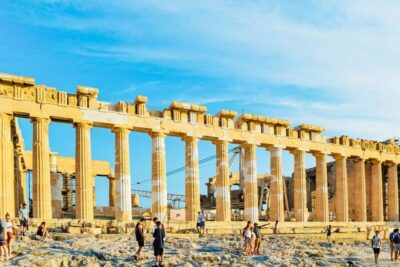
Acropolis Ticket with Optional Audio or Live Guide
Read our review →
Acropolis, Parthenon & Acropolis Museum Guided Tour
Read our review →
Acropolis: Premium Acropolis and Parthenon Guided Tour
Read our review →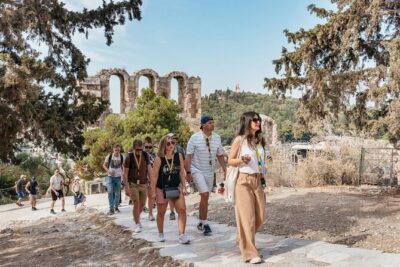


Athens Scenic Electric Bike Tour with optional Acropolis visit
Read our review →
Acropolis monuments & Parthenon Walking Tour with Optional Acropolis Museum
Read our review →Browse the lists this tour appears in