
Reviewed · METEORA MONASTERY DAY TOURS
Argolis Olympia Delphi & Meteora 4-Day Tour
A mainland Greece loop that hits hard. This Argolis to Meteora route turns big myths into a real road trip with an organized, private schedule.
I particularly like the value of a true private group set-up, since you keep your own timing and you are not stuck matching a bus crowd.
The second thing I like is the behind-the-scenes help, especially with the drivers. I have seen how careful drivers like Panos, Jimmy, Tassos, and Kyriakos keep the day smooth, offer practical restaurant ideas, and help you get oriented fast.
One drawback to plan for is cost creep, since site admission fees are not included (and can add up quickly on top of optional licensed guide add-ons).
In This Review
- Key highlights worth your attention
- How this 4-day mainland route really flows
- Day 1: Corinth Canal, Ancient Corinth, Epidaurus, Nafplion, and Mycenae
- Corinth Canal, the tiny throat between seas
- Ancient Corinth: Apollo, the Bema, and Paul’s trial setting
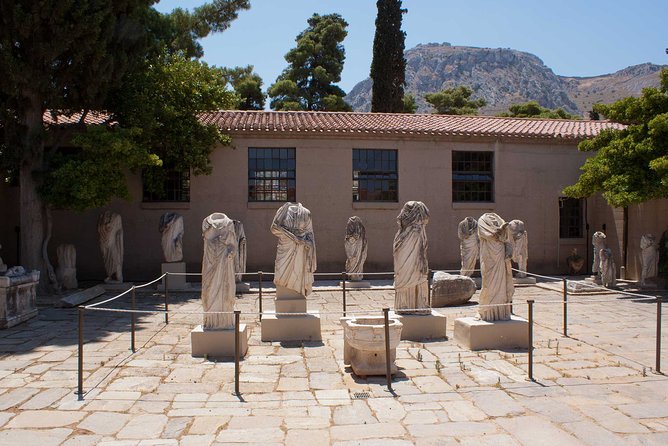
- Corinth Archaeological Museum: what the ruins can’t show
- Epidaurus Theatre: even if you only remember the acoustics
- Tolon lunch and Nafplion views: the easy “real Greece” break
- Mycenae: Cyclopean walls and the story of Agamemnon
- Overnight in Olympia
- Day 2: Olympia’s Temple of Zeus, Hera, stadium, plus the road to Delphi
- Olympia sites: Zeus, Hera, Pheidias workshop, stadium
- Olympia Museum: the objects that make the story real
- Driving toward Delphi via Rio bridge and seaside breaks
- Overnight in Delphi
- Day 3: Castalia spring, Apollo treasuries, the Delphi Theatre, and Arachova
- Castalia spring and the sanctuary complex
- Delphi Archaeological Museum: statues, architecture, and offerings
- Arachova: a quick mountain town pause
- Kalambaka next: monasteries on the horizon
- Day 4: Meteora monasteries, James Bond film location, and Thermopylae
- Meteora: visiting three of the six monasteries
- Thermopylae Museum: the 300 Spartans stop
- Price, value, and what to budget before you go
- Comfort, transportation, and the driver-guide split
- Who this tour fits best, and who might want a different style
- Should you book Argolis, Olympia, Delphi, and Meteora?
- FAQ
- Is this tour private?
- How many people can book this tour?
- What language is the tour offered in?
- Are meals included in the price?
- Are site entrance fees included?
- When can I cancel for a full refund?
Key highlights worth your attention
- Private pacing with pickup at Athens airport or Piraeus Port
- Corinth Canal plus Ancient Corinth and Epidaurus in one efficient Day 1
- Olympia’s Temple of Zeus, Temple of Hera, stadium, and museum in a focused Day 2
- Delphi oracle sites paired with the Delphi Archaeological Museum
- Meteora monasteries chosen from the six, with a sunset-style timing buffer
- Optional licensed local guides at stops, if you want deeper interpretation
How this 4-day mainland route really flows
This is a well-paced cross-section of Greece’s “big names,” packed into four days without the stress of arranging hotels, car transfers, or on-the-spot logistics. You start in Athens, drop into the Peloponnese first, then swing north toward Olympia, then west to Delphi, and finish with Meteora and a quick Thermopylae stop.
Because it is private, the schedule is yours, even if the itinerary is still busy. You are looking at moderate walking and plenty of stairs at ancient sites and in old towns, so good walking shoes matter.
The driving days are long enough that comfort counts. Expect an air-conditioned vehicle, WiFi on board, bottled water, and a professional driver who handles transportation while optional licensed guides handle the on-site storytelling.
More Delphi day tours:
- Athens: Mythology of Delphi, Museum and Arachova Guided Tour
★ 4.7 · 5,102 reviews - From Athens: Delphi Full Day V.R. Audio Guided Tour
★ 4.6 · 3,028 reviews - From Athens: Small-Group Delphi, Museum & Arachova Day Trip
★ 4.8 · 2,476 reviews
Day 1: Corinth Canal, Ancient Corinth, Epidaurus, Nafplion, and Mycenae
Day 1 has one job: get you hooked on the places where Greek mythology and real historical layers overlap.
Corinth Canal, the tiny throat between seas
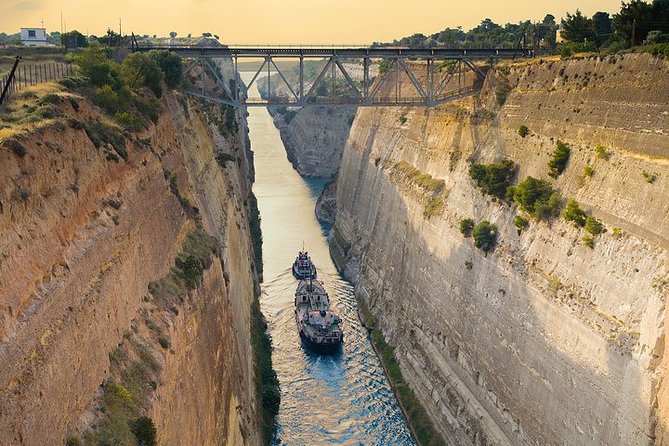
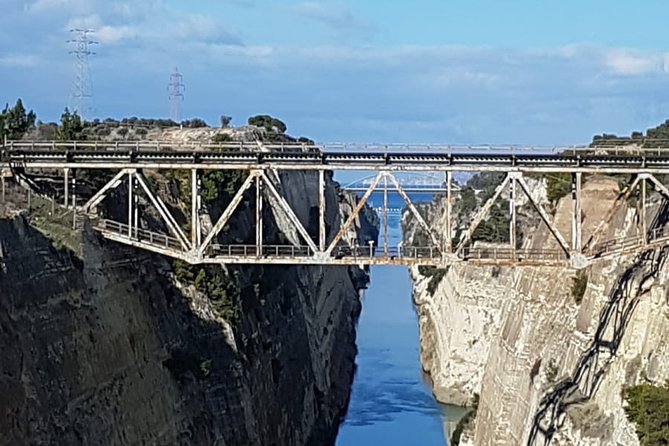
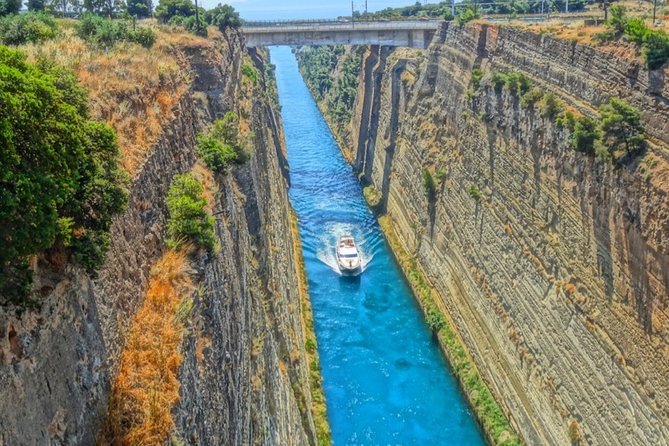
You begin at the Corinth Canal, a narrow channel cutting the Isthmus of Corinth. It is short at about 6.4 kilometers and very tight at around 21 meters wide at its base, which is part of why it is not a busy commercial passage today.
The appeal here is the perspective. You see how the Peloponnese feels like an island, and you get a useful mental map for the rest of the trip.
Ancient Corinth: Apollo, the Bema, and Paul’s trial setting
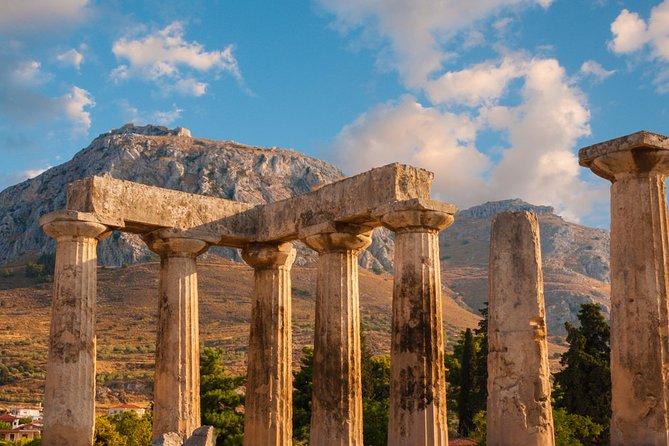
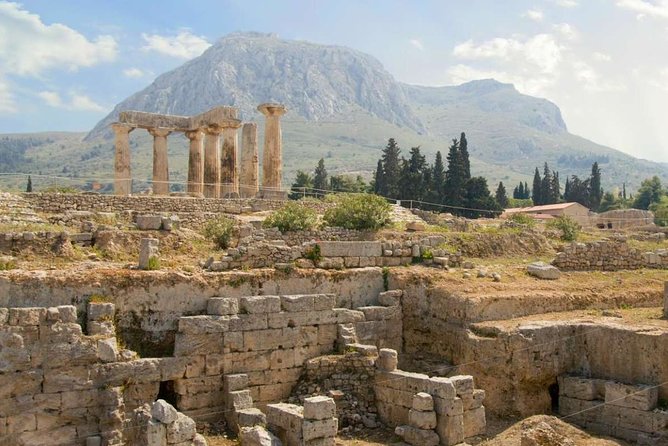
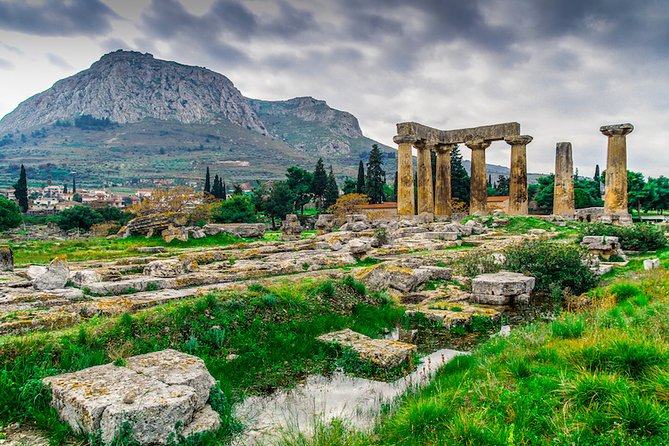
Ancient Corinth is one of those sites where you can walk through layers quickly if you know what you are looking for. You will visit the Temple of Apollo, a Doric temple built around 560 BCE, sitting on a rocky hill north of Acrocorinth.
Then there is the St. Paul connection, tied to the Bema, an elevated rostrum in the center of the Roman Forum where officials addressed the public. In Byzantine times, tradition says that Christian church use followed, turning it into a different kind of landmark.
Admission is not included here, so check your budget early. The upside is that the time is structured, so you can actually connect the dots without rushing.
More Meteora monastery days:
- Athens: Meteora Monasteries Day Trip with Caves and Lunch
★ 4.7 · 4,670 reviews - Athens to Meteora: Monasteries, Caves & Seaside Stopovers
★ 4.7 · 2,958 reviews - Athens: Full-Day Meteora Tour with Local Guide & Greek Lunch
★ 4.8 · 2,101 reviews - Athens: Meteora Monasteries, Caves & Coastal Stopovers with Lunch
★ 4.5 · 1,432 reviews
Corinth Archaeological Museum: what the ruins can’t show
The Archaeological Museum of Corinth fills in gaps that outdoor ruins cannot. You get prehistoric finds from the area, then material from the Geometric, Archaic, Classical, and Hellenistic periods, plus the Roman, Byzantine, and Frankish layers.
This is also where the Jewish community presence shows up through inscriptions and objects. If you prefer museums that explain a whole region, this stop helps you understand why Ancient Corinth mattered so much.
Epidaurus Theatre: even if you only remember the acoustics
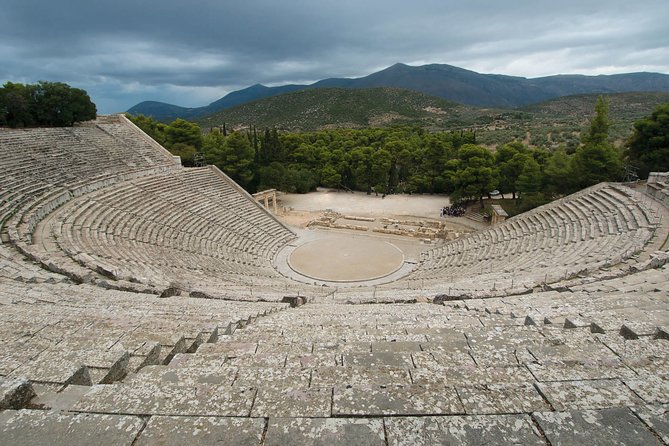
Next is the Ancient Theatre of Epidaurus. Epidaurus was a spiritual center tied to healing culture, with the Sanctuary of Aesculapius nearby, and the theatre is famous for its preserved circular orchestra.
Even if you are not a theatre nerd, you will feel why this place is special. It is one of the rare settings that still preserves much of its original shape, and it remains in use today.
Tolon lunch and Nafplion views: the easy “real Greece” break
At Tolon, you have time for lunch at a traditional family-owned restaurant with views over the Saronic Gulf. This kind of pause matters on a long day, because it keeps the trip from feeling like nonstop rushing.
Then you reach Nafplion, a port town spread across hillside streets near the Argolic Gulf. Nafplion served as capital in major moments from the Greek Revolution era into the Kingdom of Greece period, and today it still feels like a living town rather than a museum backdrop.
Mycenae: Cyclopean walls and the story of Agamemnon
You close Day 1 with Mycenae, a Late Bronze Age power center from around the 16th to 11th centuries BCE. You see the Cyclopean-style walls protecting royal families, then move through toward the Lion Gates and the route leading to the palace area.
The stop also includes the Treasury of Atreus, known as the Tomb of Agamemnon, perched on a hill opposite the palace. The timing here is smart because you are seeing both the political center and the monumental funerary statement in one go.
Overnight in Olympia
The day ends with a drive to the village of Olympia and an overnight at a local hotel. That means you start Day 2 close enough to hit the big Olympia sites without feeling like you are wasting hours in transit.
Day 2: Olympia’s Temple of Zeus, Hera, stadium, plus the road to Delphi
Olympia is where the trip becomes more than “pretty ruins.” It becomes a place where you can understand how Greek religious life, athletics, and power were tied together.
Olympia sites: Zeus, Hera, Pheidias workshop, stadium
After breakfast, you visit the Temple of Zeus, the major building at the Altis sacred precinct. It is considered the largest temple in the Peloponnese and a strong example of Doric architecture.
You also visit the Temple of Hera, connected to the Olympic Flame lighting every four years. This helps you see that Olympia is not only about the men’s games; it also ties to women’s honoring of Hera through the Heraia.
The workshop of Phedias is another highlight. It is where sculptor Pheidias crafted the chryselephantine statue of Zeus, one of the Seven Wonders of the ancient world. Even if the original statue is gone, the site location gives the right context.
Then comes the Ancient Stadium of Olympia, the place that hosted the ancient Olympic Games and the Heraia. This is the stop where the ground feels like it remembers feet.
Olympia Museum: the objects that make the story real
In the Olympia Archaeological Museum, you focus on finds from excavations across the sacred precinct, from prehistoric times through the early Christian era. The museum is especially known for sculpture and a bronze collection that is described as one of the richest in its category, along with major terracotta pieces.
If you want context that turns statues and fragments into meaning, this is a strong use of time. Admission is not included, so again, budget matters.
Driving toward Delphi via Rio bridge and seaside breaks
After Olympia, you drive toward Delphi and make photo stops. You will pass the Charilaos Trikoupis bridge, one of the world’s longest multi-span cable-stayed bridges, opened in 2004 and used to transport the Olympic Flame during the Athens 2004 period.
Then you pause near the sea at Nafpaktos Old Port and Galaxidi, a picturesque village with harbor history tied to 19th-century shipbuilding. You also stop in the area of Itea, a resort town and major port for the prefecture.
These seaside interruptions prevent the drive from feeling like punishment. It also gives your eyes a reset before Delphi.
Overnight in Delphi
You finish Day 2 with an overnight at a local hotel in Delphi. That positioning is key, because Day 3 morning includes the most important Delphi sites.
Day 3: Castalia spring, Apollo treasuries, the Delphi Theatre, and Arachova
Delphi can be intense if you go in cold. The good news is that this itinerary builds a logical storyline: sacred water, Apollo worship spaces, then public performance and civic monuments.
Castalia spring and the sanctuary complex
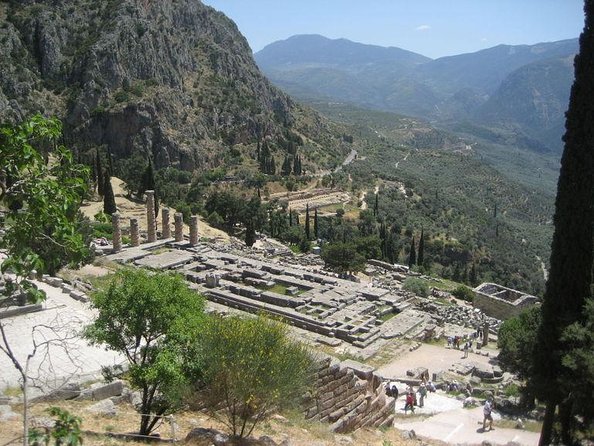
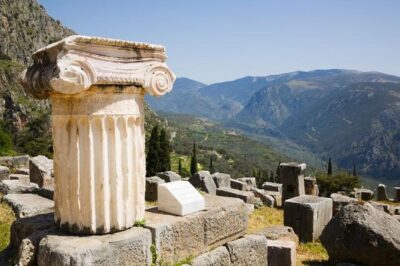
You start with Castalia spring, linked to the ancient Sanctuary of Apollo. Then you move through key sites including the Treasury of the Athenians, the ancient Stadium, and the ancient Theatre.
You will also see the bronze Charioteer, which is one of the standout museum-adjacent visual anchors for the sanctuary story. If you keep your eyes up, you will notice how each structure signals a different kind of meaning: religious, athletic, civic, and artistic.
The route continues to the Temple of Athena Pronea and the Gymnasium. You are not only seeing the Oracle stage; you are seeing the full religious landscape that supported the sanctuary’s authority.
Admission is listed as free in the plan for this visit, but do note that the Delphi Archaeological Museum has a separate admission status.
Delphi Archaeological Museum: statues, architecture, and offerings
The Delphi Archaeological Museum is where you get the objects that explain how the sanctuary evolved. You focus on architectural sculpture, statues, and smaller items donated to the sanctuary, spanning from the 8th century BCE through decline in late antiquity.
This museum is designed in a two-storey format, with multiple exhibition rooms and conservation labs. Even with limited time, it gives you a clearer mental picture of what you saw outdoors.
Arachova: a quick mountain town pause
Then you go to Arachova, about 10 km from Delphi. The plan gives you time to walk the traditional town and mix old and new atmosphere near the mountain of Apollo.
This is a good break if you want food, coffee, or simple people-watching without adding another major site.
Kalambaka next: monasteries on the horizon
You drive into the Meteora area and settle in Kalambaka. There is time to watch the sunset from the rock of Meteora, and that is a smart buffer because weather can shift fast around the cliffs.
Overnight in Kalambaka means Day 4 starts close to the monastery trailheads.
Day 4: Meteora monasteries, James Bond film location, and Thermopylae
Meteora is the big finale. You go from street-level to something that feels vertical, because the monasteries sit atop natural sandstone pillars.
Meteora: visiting three of the six monasteries
You visit three monasteries out of the six suspended choices. The Meteora Monasteries date back to the 11th century and are UNESCO World Heritage sites.
A fun and practical detail is the film reference: the James Bond movie For Your Eyes Only used the Monastery of Holy Trinity for filming. Even if you only vaguely remember the movie, seeing the spot helps your imagination lock onto the geography.
Admission is not included for Meteora sites in the plan, so this is one more line item to expect.
Plan for stairs and uneven paths. Even with short stops, the climb adds up, so go slow and drink water.
Thermopylae Museum: the 300 Spartans stop
Before the trip ends, you stop at the Thermopylae Museum area in the Hot Gates region. The visit ties to the battle in 480 BCE and the memory of King Leonidas and the Greek forces fighting the Persians.
The monument is described as being erected to remind visitors of the sacrifice. It is short, so treat it as a thoughtful pause, not the full Spartans experience.
The plan shows the museum admission as not included, so keep that in mind if you like to pay for every interpretation layer on-site.
Price, value, and what to budget before you go
At $3,329.71 per group, for up to 2 people, this is not a cheap outing. But it is also not trying to be a bargain bus tour. The value comes from a private car, structured multi-day routing across major sites, and pickup plus drop-off between Athens and your start point.
Here is where costs can shift for you:
- Admission fees are not included, listed as €116.00 per person in the plan.
- Local licensed tour guides on request are available at an additional cost of €1100 euros, depending on availability.
- Meals and hotel accommodation are not included, so you will pay those separately.
That optional guide add-on is where value becomes personal. If you know Greek myths well and only want highlights, the driver’s on-road explanations may be enough. If you want layered context for each stop, paying for licensed guides can be worth it, especially at Olympia, Delphi, and the major archaeology sites.
Also consider that this tour is private for just your group. You avoid the time loss of walking across huge parking lots, waiting for other groups, and compressing your attention span around someone else’s pace.
Comfort, transportation, and the driver-guide split
This tour keeps the transportation side simple. You get bottled water, air-conditioned comfort, and WiFi on board. Most importantly, pickup and drop-off from Athens Hotel or Piraeus Port are included.
The driver is described as professional, and they are not licensed to accompany you inside the sites. That matters because interpretation can be done by licensed local guides when available. Without that add-on, your driver can still help with orientation, timing, and practical tips, but you might miss some of the deeper on-site commentary.
One thing I like in this set-up is the habit of frequent comfort resets. Several experiences with drivers like Panos and Jimmy included small touches like making sure the vehicle stayed comfortable and keeping the day paced so you are not constantly sprinting between stops.
Because the tour is totally private, you can also handle small requests without worrying about group friction. If you need a bathroom stop, a coffee pause, or time to photograph something, you are more likely to get it handled.
Who this tour fits best, and who might want a different style
This tour fits you if you want:
- a private, no-other-passengers experience across the main classical anchors (Corinth, Olympia, Delphi, Meteora)
- a plan that handles the hard parts, like long drives and multi-site scheduling
- a chance to add licensed guide time when you feel like you want more meaning
It might not fit you if you want a slower pace or if you hate road time. The itinerary is packed with major stops, so you will spend a lot of the day moving and walking between viewpoints and ruins.
Also, the plan calls for moderate physical fitness. You do not need athlete stamina, but you should be ready for uneven ground, stairs, and longer walks at the big sites like Mycenae, Olympia, Delphi, and Meteora.
Should you book Argolis, Olympia, Delphi, and Meteora?
If this route matches your interests, I think it is a strong choice. It brings together the classic Greece names in a logical order, and the private van format protects your time. The sites are spaced so you can understand them as a sequence, not as a grab bag.
I would book this if you:
- are visiting Greece for the first time and want the biggest “greatest hits” with less hassle
- like the idea of optional licensed guides, so you can control how deep you go
- value comfortable long-distance driving and clear structure
I would hesitate if:
- you want meals and hotel included in a single price
- you dislike planning for entrance fees and optional add-ons
- you prefer a lighter itinerary with fewer major sites per day
If you go in with the right expectations, you will come away with the feeling that Greece is not just pretty, it is organized, story-driven, and still real in how people live near these ancient places.
FAQ
Is this tour private?
Yes. It is totally private, and only your group participates. Pickup and drop-off are also handled for your Athens hotel or the Piraeus Port cruise ship terminal.
How many people can book this tour?
The price is listed per group for up to 2 people.
What language is the tour offered in?
It is offered in English.
Are meals included in the price?
No. All meals are not included.
Are site entrance fees included?
No. Entrance fees are listed as €116.00 per person, and the plan also marks many site admissions as not included.
When can I cancel for a full refund?
You can cancel up to 6 days in advance for a full refund, with the cutoff based on the local experience start time.
Freshly listed near Athens
- Athens: Premium Guided E-Scooter Tour in Acropolis Area★ 5.0 · 133 reviews
- Athens: Wine Workshop Create your Own Wine under the Acropolis★ 5.0 · 77 reviews
- Ceramic and Pottery Creative Workshop with Two Local Artists★ 4.0 · 57 reviews
- Private Tour and Tasting at Zeginis Winery★ 5.0 · 18 reviews
- Athens: Greek Wines Tasting with Sommelier and Acropolis Views★ 5.0 · 88 reviews
- Private Day Trip to Nafplio from Athens★ 5.0 · 20 reviews
- Athens Old City Private Photoshoot Tour / 2 hrs★ 5.0 · 109 reviews
- Greek food and wine tasting★ 5.0 · 18 reviews
Meteora Monastery Day Tours, compared.
Meteora Monasteries Day Trip with Caves and Lunch
Read our review →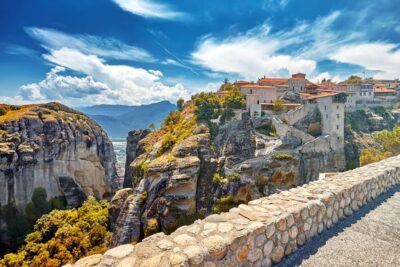
Athens to Meteora: Monasteries, Caves & Seaside Stopovers
Read our review →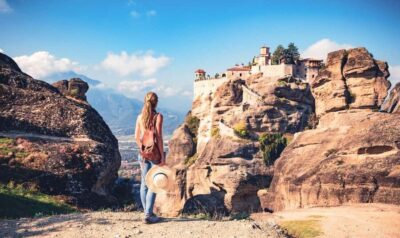
Full-Day Meteora Tour with Local Guide & Greek Lunch
Read our review →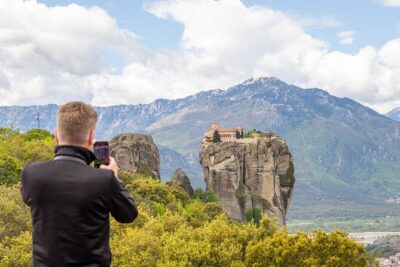
Meteora Monasteries, Caves & Coastal Stopovers with Lunch
Read our review →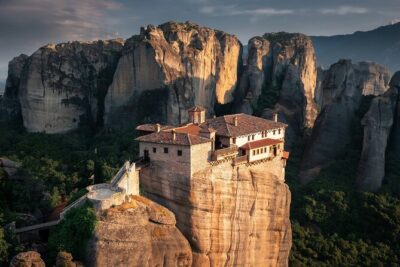
Meteora Monasteries & Caves DayTrip from Athens with Greek Lunch
Read our review →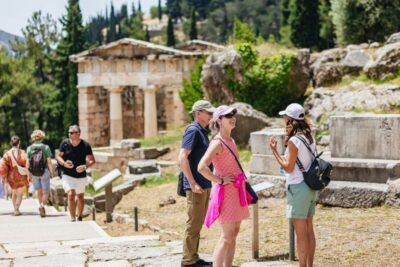
4-Day Classical Greece Tour: Epidaurus, Mycenae, Olympia, Delphi, Meteora
Read our review →Browse the lists this tour appears in